

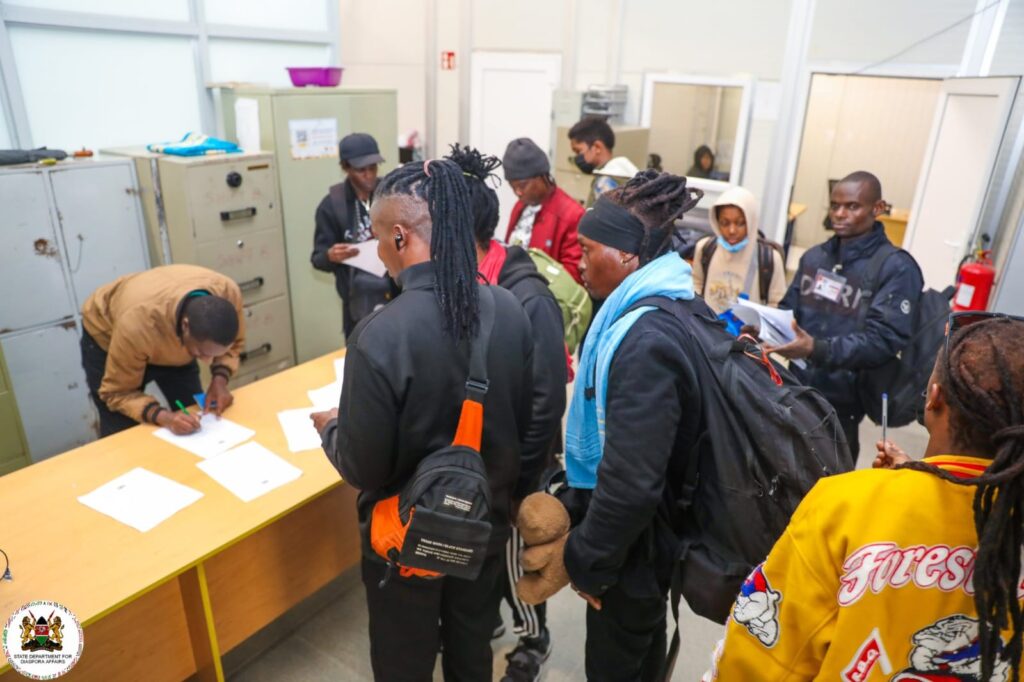
The government successfully evacuated 15 Kenyan nationals from Iran through Türkiye as tensions in the Middle East escalate. The evacuees are scheduled to arrive in Nairobi in the early hours of Sunday, March 22, 2026.
In a statement released on Saturday, March 21, 2026, the State Department for Diaspora Affairs detailed that this evacuation occurred in collaboration with Kenyan missions in Ankara and Tehran, following the activation of emergency protocols designed to ensure the safety of Kenyans affected by the conflict.
“A multi-agency team has activated emergency protocols across Kenya Missions in the region. Consequently, the State Department for Diaspora Affairs, in partnership with Kenya Missions in Ankara and Tehran, has facilitated the evacuation of 15 Kenyans from Iran via Türkiye,” stated Principal Secretary Roseline Njogu.
Njogu emphasized the importance of Kenyans in the Middle East adhering closely to guidance provided by Kenyan embassies, host governments, and official government communication channels.
The escalation in the Middle East began on February 28, 2026, when coordinated strikes by the United States and Israel targeted Iranian government, military, and nuclear facilities in Tehran and other major cities.
The conflict has resulted in the deaths of Iran’s Supreme Leader, Ayatollah Ali Khamenei, and numerous senior political and military leaders, significantly disrupting the country’s leadership structure.
In retaliation, Iran launched ballistic missiles and drone strikes against Israel and U.S. military installations throughout the region, affecting bases in the United Arab Emirates, Qatar, Kuwait, Bahrain, and Saudi Arabia.
Countries activated air defense systems, temporarily closed airspace, and critical infrastructure, including Dubai International Airport, sustained damage.
Commercial shipping through the Strait of Hormuz, a vital global trade route, was halted, and several oil and gas production and refining facilities were either attacked or shut down as a precaution.
In a related development, United Nations High Commissioner for Human Rights Volker Türk has expressed grave concerns about the humanitarian toll of the escalating conflict in the Middle East. He highlighted the rapid deterioration of the humanitarian situation, noting that civilians bear the brunt of the violence.
In a statement on Friday, March 20, 2026, Türk described the war as causing death, destruction, and unbearable suffering across the region, urging for urgent diplomatic efforts to prevent further escalation and restore peace.
“The human cost of the reckless war in the Middle East is alarming. Hostilities are occurring without regard for the immediate and long-term consequences for civilians throughout the region and beyond,” his statement read in part.
As the Kenyan government intensifies its response to the crisis, it seeks Ksh400 million to facilitate the evacuation of its nationals stranded in affected areas. The Ministry of Foreign Affairs has appealed to Parliament for approval of these funds to support the repatriation process.
Currently, an estimated 500,000 Kenyans reside across the Middle East.


