

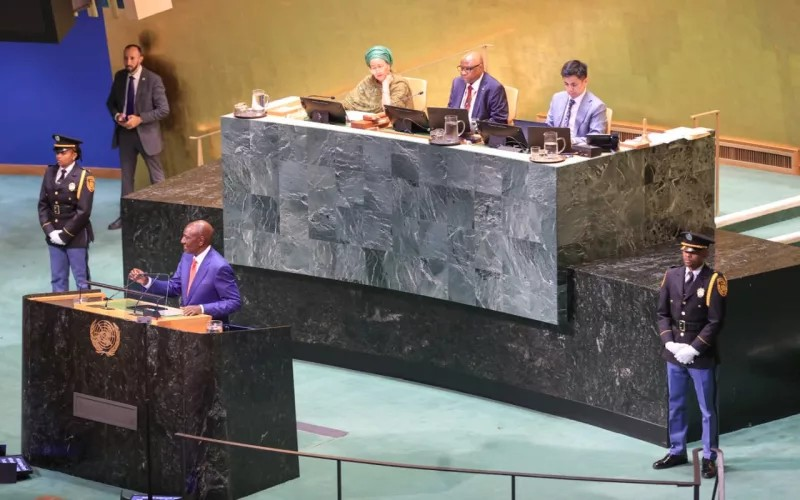
President William Ruto has urged a reevaluation of the Security Council structure that grants permanent power and veto rights to just five countries, sidelining the remaining 188 Member States.
He emphasized that Africa’s 54 nations are consistently left out of permanent membership, despite being frequently impacted by the Council’s decisions. Reform is essential to ensure Africa receives fair and permanent representation, complete with all the privileges of permanent membership.
“Every nation in this hall has one vote. Every nation is sovereign and equal under the Charter. Yet, on critical issues of war and peace, five nations wield permanent power that the other 188 do not,” he stated during his address at the 81st United Nations General Assembly in New York.
President Ruto called for immediate reform of the United Nations to rebuild trust in this vital global institution. He pointed out that nations, particularly in Africa, cannot foster confidence in a system that claims equality while maintaining structural inequalities and inconsistent application of international law.
He articulated the need for a United Nations where every nation has a voice, asserting that every country has a stake and every child has a future. “If we are serious about restoring trust, we must apply rules consistently. If we aim to manage transformation, our institutions must evolve. And if we seek a United Nations that serves everyone, then all must have a meaningful voice, a fair opportunity, and a stake in the system,” he said.
The President insisted on Africa’s right to equitable and permanent representation on the United Nations Security Council, stressing that the continent must have a significant say in decisions affecting global peace and security.
“The world has transformed, yet the Council has not. We cannot navigate transformation with institutions that resist change,” he asserted, highlighting that the existing international security framework was established when much of Africa was still under colonial rule, leaving the continent without a voice in shaping global peace governance.
“At San Francisco, only four African nations participated while the majority of our continent remained colonized,” he noted, emphasizing that in the Pact for the Future, Member States recognized the need to address historical injustices against Africa as a priority for Security Council reform.
Simultaneously, the President called for an overhaul of the international financial architecture to ensure every nation has a fair chance to secure the wellbeing of its citizens. He pointed out that development should not be most burdensome for countries in dire need of investment, while debt service overshadows education, healthcare, and opportunity.
He highlighted that global public debt reached a staggering $102 trillion in 2024, with developing nations accounting for less than one-third of that debt, yet they paid approximately $1 trillion in interest that year alone. “Forty-six developing countries now allocate more to interest payments than to health or education. Behind these figures lies a stark reality: hospitals compete with creditors, classrooms vie with debt service, and too often, creditors are prioritized,” he said.
President Ruto asserted that building a fair global economy is impossible if nations with the greatest development needs face the highest costs for development finance. He called for multilateral development banks to increase lending and for broader use of guarantees, risk-sharing instruments, long-term financing, and local currency financing to reduce investment costs.
He emphasized that international reform alone will not suffice; nations must also manage debt responsibly, strengthen institutions, deepen domestic capital markets, honor contracts, and confront corruption decisively. “Governments must play their part by managing debt wisely, preparing credible projects, and developing domestic capital markets,” he stated.
“A fairer international system demands accountability from both sides. Reform abroad cannot replace responsibility at home,” he added.
The President advocated for political and financial reforms to be accompanied by actions that ensure global institutions deliver peace, prosperity, and opportunity equitably for all. “Political and financial reforms are intertwined. They pose the same fundamental question: Will the institutions governing our shared future reflect the sovereign equality they profess, or will they perpetuate inequalities from a bygone era?” he asked.
He cautioned that failing to establish an effective United Nations capable of preventing conflict, safeguarding peace, and promoting development would have severe consequences for civilians. “When collective security falters, schools close, hospitals fail, families flee, and economies are ravaged by war. Peace is not separate from development; it is its foundation. When the institutions tasked with maintaining peace fail, it is often the youngest who bear the consequences,” he said.
President Ruto emphasized that Africa approaches the global system not just to demand change, but to offer solutions rooted in its mineral wealth, agricultural potential, renewable energy resources, youthful population, and a market of over 1.5 billion people. “Africa does not come to plead; we come to propose,” he asserted.
On a domestic note, the President announced that Kenya plans to break ground on the East Africa Refinery in Lamu, a facility capable of processing 700,000 barrels of oil daily, with an investment of $16 billion (KSh2 trillion). “Its significance goes beyond a single project or country. It embodies the Africa we aspire to build: adding value locally, creating jobs for our people, and developing industries that serve both continental and global markets,” he said.
He encouraged advocates for reform not to shy away from challenges, reminding them that the United Nations has successfully adapted its structure before. In 1963, the General Assembly approved amendments to expand the Security Council. “The Council grew from 11 to 15 members because Member States recognized the need for the institution to adapt to a changing membership. What was achievable then is achievable again,” he concluded.


