
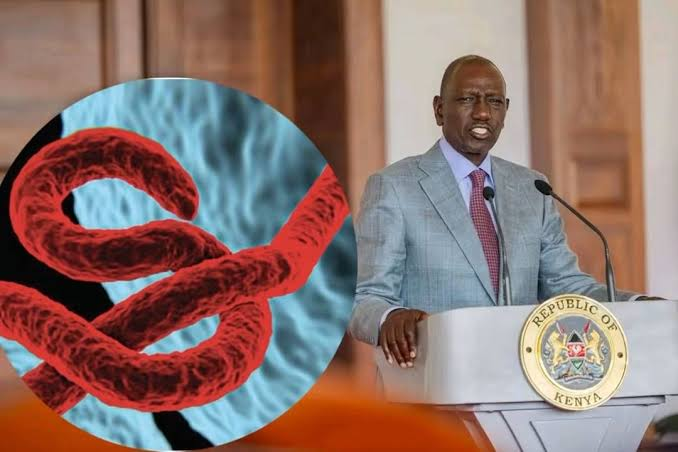
President William Ruto has called for the National Security Council Committee (NSCC) to meet and evaluate the circumstances surrounding the recent death of a patient confirmed to have contracted Ebola Virus Disease.
In his statement, the Head of State emphasized the need for the committee to propose essential measures to protect the nation from any further spread of the disease.
Following the NSCC meeting, the government has ramped up surveillance, contact tracing, and other public health initiatives to prevent additional transmission.
The government has successfully traced eight family members of the deceased, placing them under quarantine and ensuring they receive daily symptom monitoring.
Additionally, twenty-one healthcare workers who provided care to the deceased are now in quarantine and undergoing close observation. The government has also extended contact tracing to passengers who traveled on the same flight as the deceased.
So far, officials have identified and reached out to 27 passengers who may have been in contact with the deceased, implementing appropriate public health measures for their safety.
The government confirmed that the deceased has been buried in accordance with established public health protocols.
In total, 652,584 travelers have been screened. Surveillance and rapid response teams are actively working on the ground, building on the robust preparedness and surveillance systems that Kenya has maintained since the Ebola outbreak began in May 2026.
Kenya possesses the capability to detect, isolate, and manage suspected cases effectively.
As of October 6, 2026, the country has tested 267 samples across five laboratories: the National Virology Reference Laboratory (NVRL), KEMRI Nairobi, KEMRI Kisumu, and two mobile laboratories at the Busia and Lwakhakha borders. Of the samples tested, only one returned positive, that of the deceased patient, with no additional positive cases identified.
The government has trained 4,971 healthcare workers at both national and local levels in Ebola prevention, detection, and management.
Designated facilities for managing Ebola Virus Disease include Kenyatta National Hospital with eight beds, Moi Teaching and Referral Hospital with 50 beds, National Police Hospital with 49 beds, and The Nairobi Hospital with 143 beds, along with various county isolation centers. The government assures that capacity will expand as needed.
Kenya is well-prepared to address this public health emergency and will continue to enhance surveillance, contact tracing, testing, and treatment capacity as the situation develops.
The government encourages Kenyans to remain calm and vigilant, practicing strict hand hygiene and avoiding contact with individuals showing symptoms associated with Ebola Virus Disease, such as fever, severe headache, muscle pain, weakness, vomiting, diarrhea, and unexplained bleeding.
Anyone experiencing these symptoms, especially after possible exposure to a suspected or confirmed case, should avoid close contact with others and seek guidance and care from a recognized health facility.
The public is also urged to report any suspected cases of Ebola Virus Disease or individuals displaying symptoms to health authorities immediately.
The Ministry of Health will provide further guidelines on safeguards and preventive measures for individuals and institutions to minimize the risk of transmission.
The government is committed to closely monitoring the situation, taking all necessary actions to protect the public, and keeping Kenyans informed of any further developments.