

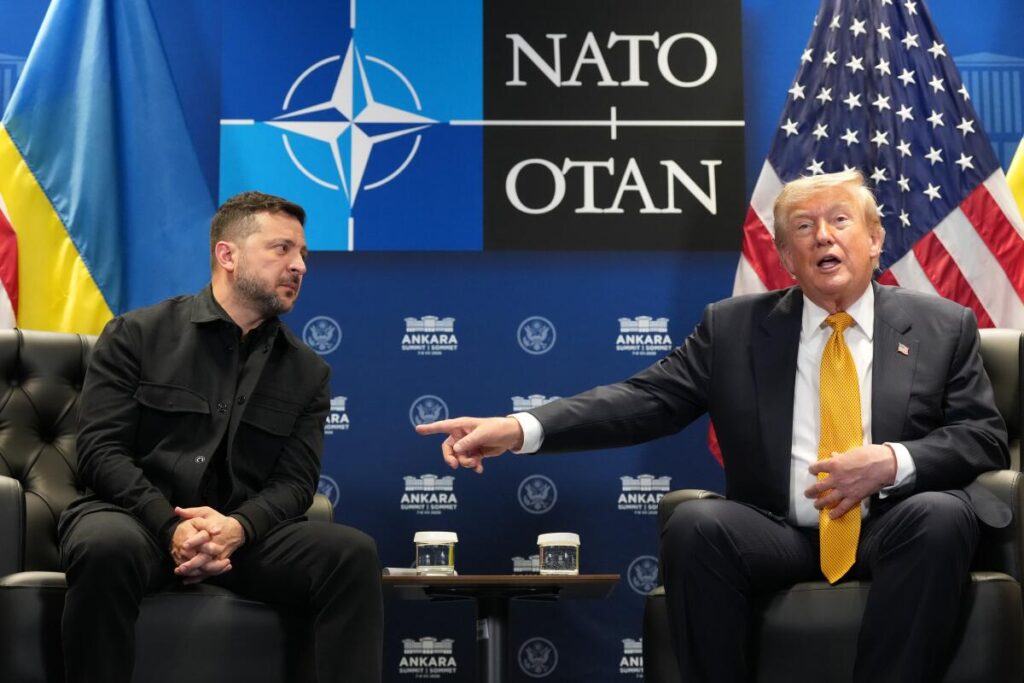
President Donald Trump recently held separate meetings with Ukrainian President Volodymyr Zelensky and Israeli Prime Minister Benjamin Netanyahu, which the White House described as “positive and productive.”
Both leaders visited Washington to attend the funeral of Senator Lindsey Graham, a strong supporter of Israel and advocate for U.S. aid to Ukraine, who passed away earlier this month.
During their meeting, Zelensky expressed Ukraine’s desire for U.S. assistance in strengthening its air defenses.
Netanyahu’s visit coincided with a time of strained U.S.-Israel relations due to differing perspectives on Iran.
Prior to his visit, Zelensky aimed to encourage Trump to fulfill a commitment made at this month’s NATO summit regarding a license for Ukraine to produce Patriot interceptor missiles.
Ukraine has long sought American Patriot missiles, which it believes are crucial for defending its cities against escalating Russian drone and missile attacks.
Trump shared on Truth Social that the closed-door meeting “went very well!”
While the U.S. has not officially confirmed military assistance to Ukraine, Zelensky stated afterward that Trump agreed to grant licenses for domestic production of Patriot missiles.
“He accepted that he will give us licenses,” Zelensky told Fox News. “I also met with representatives from strong military production companies in the United States. I hope that we will engage in co-production.” The BBC has requested a comment from the White House.
Zelensky also connected with a bipartisan group of U.S. lawmakers just before the Senate overwhelmingly voted to sanction buyers of Russian oil and gas.
He conveyed to reporters that such sanctions represent a “big signal to Europe, a big signal to Ukraine, and a significant support for our people.”
The Patriot system stands out as one of the few air defense systems capable of intercepting ballistic missiles, which Russia increasingly employs to target Ukrainian cities.
It can intercept rockets with flight ranges of up to 1,000 km (620 miles), with one battery capable of simultaneously tracking eight targets and detecting over 100.
However, each missile carries a hefty price tag, estimated between $3 million to $5 million.
Zelensky and the Ukrainian military have previously indicated that Ukraine requires 25 Patriot interceptor systems.
In addition to enhancing Ukraine’s military capabilities, domestic production of Patriots could bolster Zelensky’s approval ratings following recent protests over his decision to dismiss a popular defense minister.
A critical consideration is where Ukraine might produce these systems discreetly, away from the Kremlin’s scrutiny, and whether it can be accomplished swiftly enough to impact the conflict’s dynamics.
Shortly after Zelensky departed on Tuesday, Netanyahu arrived at the White House for discussions expected to focus significantly on the situation in Iran.
Once-friendly relations between Netanyahu and Trump have grown tense in recent months, with Trump frequently criticizing Israel for its ongoing strikes in Lebanon and for disregarding a ceasefire.
After their meeting, Trump remarked on Truth Social that it was “a very good meeting!”
Netanyahu informed Israeli media that they had reached “an understanding of a shared goal: to ensure that Iran does not obtain nuclear weapons, among other objectives.”
He added, “This was one of the best conversations I have had with the president of the United States.”
A photograph shared on Netanyahu’s X account captured the two leaders in the Oval Office, smiling at the camera.
Following their meeting, the U.S. military reported that Iranian forces attempted a surprise attack on American forces in the Middle East, but all missiles were effectively intercepted.
Meanwhile, U.S. and Saudi forces targeted Iranian proxies in eastern Iraq, who allegedly launched drones at Saudi energy infrastructure, according to the U.S. military. Tehran has not yet responded.


