

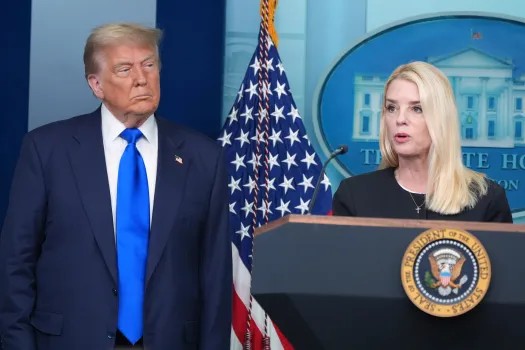
U.S. President Donald Trump dismissed Attorney General Pam Bondi on Thursday, expressing frustration with her handling of the release of files related to the late sex offender Jeffrey Epstein.
Sources indicated Trump believed Bondi was not pursuing criminal charges against his critics swiftly enough. In a social media update, Trump announced that Deputy Attorney General Todd Blanche, a former personal attorney, would temporarily lead the Justice Department.
Trump praised Bondi as a “Great American Patriot” who contributed to a significant crime crackdown and mentioned she would transition to a private sector role soon, although details remained undisclosed.
In her own statement, Bondi described her experience leading Trump’s initiatives as an “honor of a lifetime” and stated she would assist Blanche during the transition. Blanche expressed gratitude to Trump and commended Bondi, vowing to prioritize America’s safety.
Throughout her time as the nation’s top law enforcement official, Bondi aggressively supported Trump’s agenda, disrupting the Justice Department’s traditional independence from the White House. However, persistent criticism regarding the Epstein files, including from Trump allies and some Republican lawmakers, overshadowed her tenure.
Bondi faced accusations of mishandling the release of records concerning Epstein’s sex-trafficking investigations. Trump reportedly informed Bondi of her dismissal during a White House meeting, with allies urging him to act decisively.
Multiple sources confirmed that Trump had voiced dissatisfaction with Bondi’s performance over recent months. He considered other candidates for her replacement, including Lee Zeldin, the EPA administrator.
Bondi spent Wednesday with Trump, attending various events, including a visit to the U.S. Supreme Court, where his administration faced scrutiny over its stance on citizenship.
The controversy surrounding the Epstein files has posed political challenges for Trump, reigniting questions about his past relationship with Epstein. Bondi’s departure may signal a shift in strategy at the Justice Department, potentially intensifying legal actions against Trump’s opponents.
Bondi is the second high-ranking official to be removed recently, following Homeland Security Secretary Kristi Noem’s ousting on March 5 due to management criticisms.
As a former Florida state attorney general, Bondi aimed to refocus the Justice Department on violent crime and restore trust among Trump’s supporters after federal prosecutors charged him twice during his time out of office. Critics accused her of undermining the DOJ’s commitment to impartiality by removing numerous career prosecutors involved in investigations against Trump.
“Pam Bondi took a sledgehammer to the Justice Department and its workforce,” stated Stacey Young, a former DOJ lawyer and head of Justice Connection, an organization supporting expelled career staff.
Bondi’s leadership saw a significant departure of career attorneys from key DOJ units and a close alignment with Trump, whose image now features prominently at the department’s Washington headquarters.
The DOJ has pursued investigations against Trump’s critics, including criminal charges against former FBI Director James Comey and New York Attorney General Letitia James. However, these cases faced legal challenges, with a judge ruling against the Trump-appointed prosecutor involved.
“Pam Bondi’s legacy will be the weaponization of the world’s preeminent law enforcement agency for Donald Trump’s personal benefit, but apparently even she didn’t go far enough to appease him,” remarked Senator Dick Durbin, the top Democrat on the Senate Judiciary Committee.
Bondi defended her handling of the Epstein files, claiming the Trump administration was more transparent than previous administrations. At a House committee hearing in February, she responded to criticism with political attacks.
Last year, Bondi stirred speculation about the Epstein files, suggesting a client list was under review. Following an initial release of largely public material, the DOJ and FBI declared the case closed in July, prompting further criticism and the passage of a bipartisan law in November mandating the release of nearly all related files.
Despite releasing approximately 3 million pages, controversy persisted as lawmakers criticized redactions and the exposure of some Epstein victims’ identities. The Republican-led House Oversight Committee voted to subpoena Bondi, and she was scheduled to testify on April 14.


