

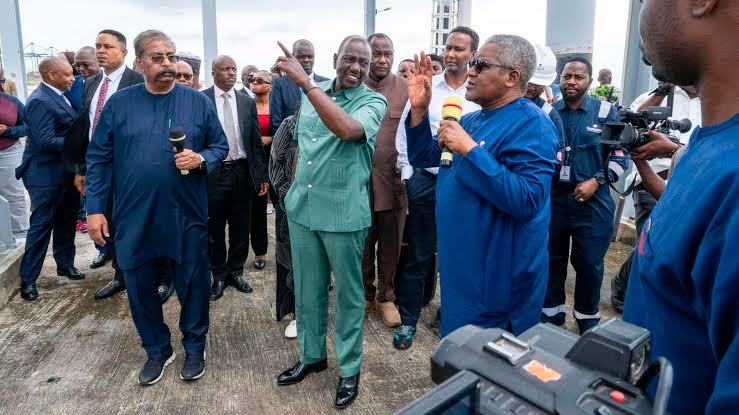
President William Ruto confidently announced that the groundbreaking ceremony for the Ksh2 trillion East Africa Refinery in Lamu will take place as scheduled on Wednesday.
He will lead this significant event at Lamu Port, welcoming several regional leaders and esteemed dignitaries.
During a recent visit to Kilifi, where he issued title deeds to residents, Ruto emphasized that the refinery will revolutionize Kenya’s economy and generate thousands of jobs.
“By God’s grace, Inshallah, we will launch the Sh2 trillion refinery in Lamu tomorrow. This project will significantly impact our national economy,” Ruto stated.
He addressed those opposing the project, accusing them of trying to hinder investment through legal challenges and public remarks.
“Some believe they can sabotage the investment in this refinery. I have observed their attempts on social media and at press conferences. Let me assure you, we will not be misled,” he said.
Ruto also criticized previous efforts by brokers to obstruct major investments in Kenya, highlighting how these actions have deprived the country of valuable projects.
He recalled Nigerian businessman Aliko Dangote’s earlier plans to establish a cement plant in Kenya, which fell through due to disputes over shares and other conditions.
Ruto mentioned the plans for Uganda to build a crude oil pipeline through Kenya to Mombasa, which ultimately shifted to Tanzania.
His comments followed a recent move by 133 residents of Chandavai in Lamu, who approached the Malindi Environment and Land Court to halt refinery-related activities, citing concerns over ancestral land ownership, compensation, and resettlement.
However, the court upheld the planned groundbreaking and instructed all parties to maintain the status quo regarding the disputed land, LR No. 13061, pending a hearing on October 14.
The residents believe their ancestral land should not be utilized for the project until their compensation claims and resettlement issues are resolved.
Backed by the Dangote Group, the refinery is projected to process 700,000 barrels of crude oil daily and supply refined petroleum products to Kenya and the broader East African market. The government envisions this project as a catalyst for increased investment, industrialization, and job creation, with Ruto estimating around 60,000 new jobs.


