

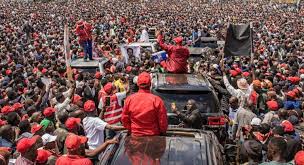
A charged political atmosphere has enveloped the Gusii region as the United Opposition establishes a presence in what was once a stronghold for the Orange Democratic Movement (ODM).
From Ekerenyo Grounds to Kisii Stadium, the impressive turnout reveals a narrative that leaders aligned with President William Ruto may prefer to ignore: the political landscape is shifting rapidly.
At Ekerenyo Grounds, the venue overflowed with tens of thousands who came to warmly welcome the United Opposition team. The enthusiastic crowds later surged into Kisii Stadium, where Jubilee Deputy Party Leader Fred Matiang’i and his colleagues concluded their campaign trail across Nyamira and parts of Kisii counties.
On February 24, 2026, the caravan will move to Kitutu Chache North and Kitutu Chache South, culminating in Nyaribari Chache, with rallies scheduled to wrap up on Wednesday in South Mugirango and Bomachoge.
For a region long viewed as ODM’s stronghold, the visual evidence is compelling. The party linked to the late opposition leader Raila Odinga appears to be relinquishing its once firm control, while the ruling United Democratic Alliance (UDA) struggles to make significant inroads.
Instead, Jubilee, under Matiang’i’s leadership, is emerging as the new focal point for the region.
Matiang’i, already endorsed by Jubilee to run for president in 2027, is not merely making courtesy calls. His tour represents a strategic effort to unify Gusii into a cohesive voting bloc that can support a broader joint opposition ticket.
In a political landscape marked by elite alliances, tactical ambiguity, and vocal propaganda, Matiang’i embodies the one factor Ruto has found challenging to counter: a blend of competence and regional respect.
Recent political developments reinforce this perception. On November 27, 2025, pro-Matiang’i candidates won all three by-elections in Nyamira’s Nyamaiya, Nyansiongo, and Ekerenyo wards, signaling that his political brand resonates with local constituents.
These victories unsettled both ODM supporters and UDA allies, some of whom have publicly downplayed the momentum as fleeting.
However, the increasing endorsements surrounding Matiang’i suggest a different narrative. MPs Patrick Osero (Borabu), Anthony Kibagendi (Kitutu Chache South), Obadia Barongo (Bomachoge Borabu), and Clive Gisairo (Kitutu Masaba) have openly supported him, bolstering his grassroots mobilization efforts.
Kisii Senator Richard Onyonka framed the rallies as a crucial test of the community’s commitment.
“This team aims to verify whether you genuinely support your own candidate, Matiang’i, or if it’s merely talk. This is your chance to show that he has our backing and that they can count on it,” he stated.
The broader opposition strategy is equally calculated. Former Deputy President Rigathi Gachagua, now leading the Democracy for Citizens Party, emphasized the necessity of robust regional bases in negotiating national power.
“Mobilization for bargaining power must initiate from each leader’s base. Comprehensive discussions in Mt Kenya led to the formation of DCP,” Gachagua noted.
“It is only through a strong local foundation that one can effectively negotiate presidential aspirations. Mt Kenya is a distinct voting bloc with interests best understood by its own people.”
During the three-day tour in Keroka, Gachagua was particularly direct in rallying Gusii support for Matiang’i.
“I want us to agree; I will take Matiang’i to Mlimani to meet his cousin. For the people of the mountain to respect him, he must be respected here at home. I do not want young people coming to insult Matiang’i,” he asserted.
His comments followed Matiang’i’s recognition as a Kisii elder and community spokesman, a symbolic endorsement solidifying his status as the region’s dominant political figure.
President Ruto’s strategy for 2027 increasingly appears focused on fracturing opposition strongholds and leveraging elite agreements, notably the discussed UDA-ODM collaboration, to ease resistance in perceived hostile areas.
Yet in Gusii, this strategy faces an unusual challenge: consolidation rather than division.
Even UDA allies like South Mugirango MP Silvanus Osoro express public confidence. However, many local leaders privately acknowledge that the political landscape is becoming precarious for both UDA and ODM representatives.
Thousands of residents from Keumbu, the hometown of the late Simeon Nyanchae—the last Gusii leader to make a serious presidential bid in 2002—turned out in symbolic defiance, recalling memories of past regional unity. The message was clear: the community is recalibrating.
Whether this momentum will sustain until 2027 remains uncertain. However, for now, the United Opposition has accomplished what many deemed unlikely: transforming ODM’s former fortress into a contested arena and positioning Gusii as a crucial battleground in Kenya’s evolving succession politics.


