

Many Kenyans and fellow Africans express significant concern over the rising cost of living. Rather than focusing solely on subsidies and price controls, governments are implementing various strategies to enhance citizens’ incomes.
Leading this initiative, major economies like Kenya and South Africa have introduced interventions aimed at increasing disposable income and expanding wealth-creation opportunities for low-income earners.
Despite official data indicating a decline in inflation and gradual macroeconomic progress, public discontent remains high across the continent. Many households contend that the benefits of stabilization have yet to yield tangible relief, turning this issue into both a political and economic debate.
In Kenya, Treasury Cabinet Secretary John Mbadi defended proposed tax reforms designed to protect low-income earners. He acknowledged the public’s concerns about rising prices eroding earnings and diminishing household purchasing power.
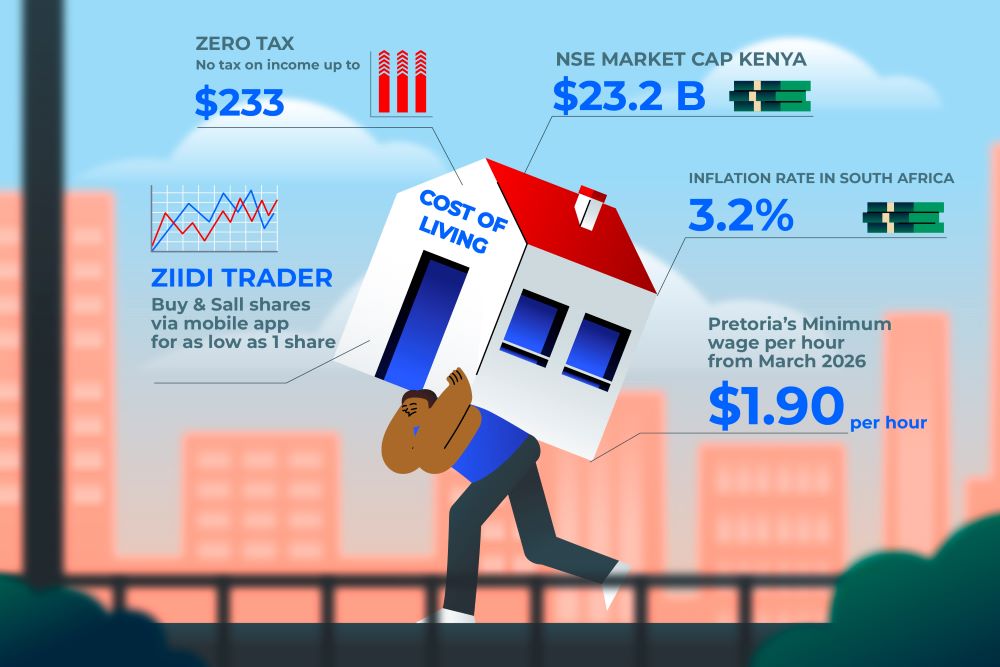
“We have consistently heard the call to put money back into people’s pockets, as purchasing power has significantly declined,” Mbadi stated during a bell-ringing ceremony to launch Safaricom’s Ziidi Trader, a new service enabling Kenyans to buy and sell shares of publicly listed companies directly through the M-Pesa mobile platform.
Mbadi highlighted that individuals earning Sh30,000 and below would pay no tax, adding that even those earning higher amounts would benefit from this exemption on their first Sh30,000. Furthermore, the government plans to reduce the tax rate for the income bracket just above Sh30,000 from 30 percent to 25 percent, a move Mbadi framed as significant relief for low-income households.
Kenya is also taking steps to eliminate longstanding barriers to capital market participation, integrating retail investment into its broader strategy to address the cost of living crisis. The launch of the Ziidi Trader platform is anticipated to expand access for millions of citizens, particularly low-income earners who have historically been excluded from formal investment opportunities.
During the launch, President William Ruto praised the platform’s transformative potential. “This platform marks a pivotal shift in how citizens engage with the stock exchange, broadening market participation like never before,” he remarked.
How It Works
The platform empowers investors to purchase as little as a single share through their mobile phones, following regulatory reforms that have removed mandatory broker intermediation and eliminated the previous minimum investment threshold of Sh50,000. These changes significantly reduce entry barriers to the Nairobi Securities Exchange.
“For a long time, the investment process seemed overly complicated,” Ruto noted. “With serious accounts and brokers involved, it felt inaccessible. Now, the mama mbogas and boda boda operators can trade shares conveniently from their motorbikes using their phones.”
The President expressed optimism that these reforms have already correlated with a notable increase in market activity, with the total market capitalization at the NSE soaring from approximately Sh1.2 trillion three years ago to nearly Sh3 trillion last year. He predicted that the number of Kenyans participating in capital markets could rise from the current 200,000 investors to millions in the near future.
Empowerment or Politics?
However, some critics argue that these reforms are politically motivated, pointing out that they coincide with Ruto’s approach to a second-term bid after being elected on a bottom-up economic transformation agenda. In response, Mbadi countered that restoring purchasing power is a valid policy goal.
“If this serves as a campaign tool that puts money back into the pockets of Kenyans, then it is a sound campaign strategy,” he asserted.
Kenya’s National Treasury emphasized that it has mitigated the risk of near-term debt distress while stabilizing key macroeconomic indicators, including inflation and currency stability. Mbadi referenced Moody’s recent rating action as evidence of improved fiscal credibility, stating that the agency’s favorable assessment reflects growing confidence in Kenya’s economic trajectory.
“It is no coincidence that Moody’s has indicated we now have a stable economy,” he remarked. “While some may claim the economy is struggling, our recent rating improvement from CAA1 with a positive outlook to B3 with a stable outlook tells a different story.”
Last year, Kenya experienced an inflation peak of 4.6 percent, primarily driven by food, transport, and energy costs. The shilling’s relative stability has been attributed to easing price pressures.
Supporting Laborers
In South Africa, the government announced a 5 percent increase in the national minimum wage to R30.23 (Sh244) per hour starting next month, with domestic and farm workers expected to benefit the most. This increase is viewed as a significant boost, as it surpasses the inflation rate and exceeds expectations from businesses and analysts, providing much-needed relief to consumers.
“The increase will inject essential stimulus into the economy, fostering growth and supporting job creation,” stated Matthew Parks, South Africa’s Parliamentary coordinator for organized labor.
Conversely, AgriSA, South Africa’s largest farmers’ lobby, cautioned that wage adjustments alone may jeopardize employment sustainability, potentially exacerbating unemployment rather than enhancing worker welfare. AgriSA CEO Johann Kotze pointed out that the timing of the wage increase could further strain a sector still recovering from drought, climate volatility, and animal disease outbreaks.
He noted that the livestock industry contributes 40 to 45 percent to agriculture’s share of the Gross Domestic Product, emphasizing the fragility and unevenness of the sector’s recovery.
Statistics South Africa reported an average inflation rate of 3.2 percent last year, the lowest in 21 years. However, the annual rate for food and non-alcoholic beverages closed at 4.4 percent in December.


