

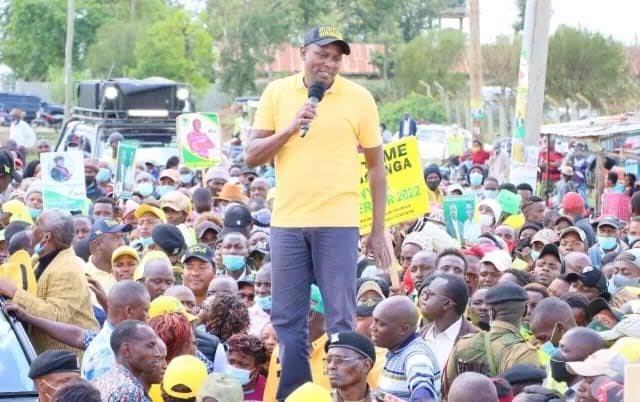
National Assembly Majority Leader Kimani Ichung’wah has decisively reaffirmed his commitment to the United Democratic Alliance (UDA), firmly stating that he will not entertain joining the Democratic for Citizens Party (DCP), which he described as a “small party,” in light of the upcoming 2027 general election.
In a recent interview with a local TV station on August 12, 2026, Ichung’wah emphasized that his political choices stem from deep-seated convictions rather than mere electoral convenience or survival strategies.
The Kikuyu MP categorically dismissed any suggestions of defecting to DCP, asserting, “Over my dead body, join that small party,” when questioned about the possibility of leaving UDA.
As political realignments heat up ahead of the 2027 elections, many politicians and parties are recalibrating their alliances and loyalties. However, Ichung’wah stands firm in his belief that his political history reflects unwavering principles, rather than opportunistic maneuvers for power.
“I make decisions rooted in conviction, not political expediency,” he stated, highlighting his political journey over the last 15 years. He noted his support for President Uhuru Kenyatta and William Ruto in 2013 through the Jubilee Coalition, a collaboration formed by The National Alliance and the United Republican Party. He continued to back these leaders through the 2017 election and subsequently supported Ruto and the UDA-led Hustler movement.
Ichung’wah believes his ongoing association with the Kenya Kwanza administration aligns with what he perceives as the right political trajectory for the nation. He passionately defended the broad-based government, asserting that his backing is rooted in the conviction that it can propel Kenya toward progress.
“I have never acted out of political convenience,” he affirmed, emphasizing that he would not compromise his principles for the sake of maintaining his position. His consistent approach to political leadership is evident in his actions and words, as he stated, “I do and say things out of conviction. If I lack conviction on a matter, I will remain silent.”
Moreover, Ichung’wah firmly rejected the notion of ethnic-based political mobilization, clarifying that he has never engaged in politics centered around ethnic identity. He remains steadfast in this principle, asserting that he would not forsake it for political office or financial incentives.
These statements emerge during a pivotal time in Kenya’s political landscape, characterized by increasing discussions surrounding coalition-building, defections, and the emergence of new political alliances as the 2027 elections approach.


