

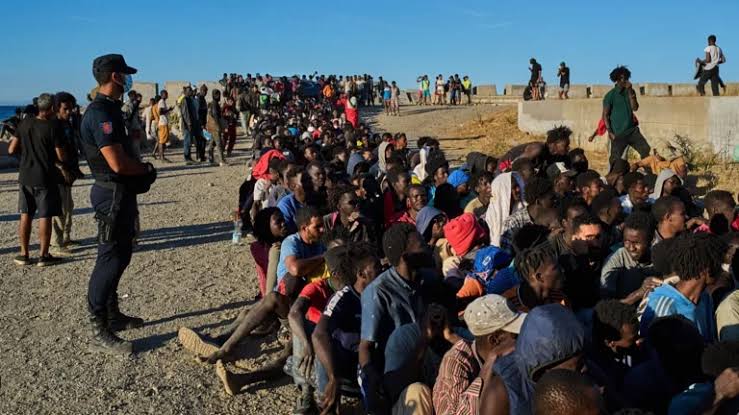
Between 3,000 and 5,000 migrants currently remain in Ceuta, Spain, following a significant influx of approximately 78,000 individuals from Morocco last week, according to the region’s leader, Juan Jesús Vivas.
Vivas expressed his deep sorrow to the European Parliament, highlighting the tragic loss of 100 lives during this crisis. His remarks coincide with increasing calls for mass crossings circulating on social media, as reported by Moroccan media.
This situation has heightened tensions among EU nations with open borders and has drawn criticism towards the Spanish government. However, the EU Commission praised Spain for its rapid response, which included deploying armed forces to Ceuta and Melilla.
While addressing the European Parliament on August 6, 2026, Vivas criticized the national government for its delayed and inadequate response, sharing that he had directly communicated these concerns to Socialist Prime Minister Pedro Sánchez. He emphasized that the lack of data on the number of migrants still in Ceuta reflects the limited resources available to manage the crisis. Local officials had previously warned about the potential for increased migrant crossings, but those warnings went unheeded.
Vivas acknowledged that although the return of nearly 75,000 migrants to Morocco has significantly eased the situation, Ceuta has not yet returned to normalcy. He pointed out that a humanitarian emergency persists, along with disturbances to public order. He also noted the complexities involved in returning unaccompanied minors, as such actions require their consent.
Spain’s interior minister announced a €25 million allocation to support minors in Ceuta. However, Spanish newspaper El Mundo reported that volunteer groups have identified 4,860 migrant children—double the official estimates. A volunteer remarked on the unsustainable nature of the current situation, as neighbors are taking children into their homes.
As of now, no migrant children have been relocated to mainland Spain, with local right-wing authorities hesitant to accept them, according to El País. While some right-wing factions cite an agreement with Morocco regarding the return of migrant children, the conservative leader in Melilla has called for a “gesture of solidarity” from their colleagues on the mainland.
The reasons behind the recent surge of migrants attempting to cross into Ceuta remain unclear. EU Migration Commissioner Magnus Brunner suggested that criminal networks spreading misinformation may be responsible, a claim that Sánchez supported. This surge followed a ruling by Spain’s Supreme Court, which stated that migrants intercepted at sea cannot be summarily returned to Morocco.
The crossings raised questions about the actions of Morocco’s border guards, with Vivas describing the incident as an “unequivocal attack.” He expressed the community’s feelings of sadness, helplessness, anxiety, fear, and concern about the possibility of future occurrences.
In response, Spain’s interior minister stated that he is working diligently with Morocco to prevent further violations and ensure the prompt return of any remaining migrants to Ceuta. Brunner emphasized that the EU should leverage its resources, including visa policies and trade, to secure cooperation from Morocco on migration matters.
Morocco attributed the crisis to Spain’s Supreme Court ruling, with an unnamed government source suggesting that the judicial decision undermined the deterrent effect of their migration control system. Meanwhile, Moroccan media reported new online calls for coordinated mass border crossings, reminiscent of the recent influx, despite warnings from authorities about potential legal repercussions for those promoting irregular migration.
The crossings have also created diplomatic tensions among EU nations within the Schengen area. Italy suspended its Schengen agreement with Spain, supported by Finland and Denmark, while the Czech Republic called for a temporary suspension of Spain’s membership, despite Sánchez clarifying that Ceuta is not part of the Schengen area. Brunner stated that the EU is prepared to increase its support in Ceuta but has yet to receive an additional request for EU border guards from the Spanish government.