
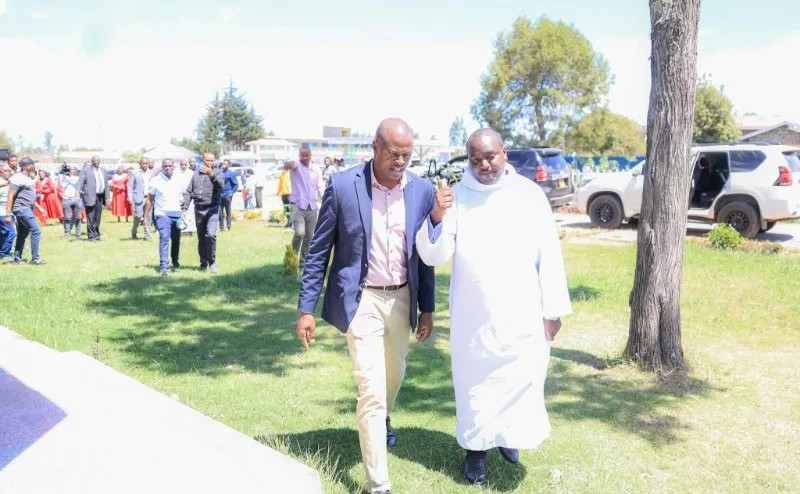
The recent encounter between Ndindi Nyoro, the leader of the People’s Party of Kenya, and Kwenya Thuku, the Kinangop Member of Parliament, at St. Paul’s Engineer ACK Church on September 20, 2026, has shed light on the evolving political dynamics in Mt. Kenya as we approach the 2027 General Election.
At first glance, their disagreement seemed to revolve around a visit. Nyoro had come to Kinangop for a church service and subsequent political engagement, while Kwenya, the incumbent MP, expressed concern about being informed prior to the visit.
However, this exchange quickly highlighted a more significant issue: the question of whether political leaders can still assert exclusive control over their traditional areas of influence.
Nyoro challenged the notion of political territory, stating that he has visited many places, including Isiolo, and doesn’t feel ownership over any town, including Murang’a. This statement encapsulates the central political tension revealed by the incident. Kenya’s electoral politics has historically been organized around constituencies, ethnic blocs, and local networks, but as we head toward 2027, politicians are increasingly seeking influence beyond their established bases.
For Nyoro, his visit to Engineer was a strategic move to promote his political agenda beyond Kiharu. Kwenya’s response illustrates the sensitivity surrounding the arrival of an external political figure in an area where an incumbent has a well-established network. He emphasized that the disagreement should not overshadow the church service, expressing his intention to welcome Nyoro as a friend and brother in Kinangop.
The contrasting approaches of the two leaders are notable. Nyoro utilized the platform to advocate for broader political freedom and the right of leaders to engage with different regions. In contrast, Kwenya focused on local leadership, respect, and developmental priorities. This distinction highlights the competing political narratives emerging in Mt. Kenya.
Nyoro is increasingly articulating a vision of political realignment through the People’s Party of Kenya, aiming to break from traditional party structures and forge new coalitions ahead of 2027. Kwenya, on the other hand, remains aligned with the Kenya Kwanza administration, showcasing local development projects, including the elevation of Engineer to municipality status.
This church confrontation is significant as it brings these competing political narratives into a shared space. The political landscape in Mt. Kenya is evolving, and the old belief that political influence can be neatly contained within constituencies is becoming harder to maintain. Since the 2022 election, former allies have shifted to different camps, new parties are emerging, and politicians are exploring distinct paths toward 2027.
Nyoro’s shift in political alignment is particularly noteworthy, as he was previously closely associated with President William Ruto’s administration. His departure from UDA has transformed him from a government-affiliated figure into one seeking to establish an alternative political platform, inevitably putting him in competition with those who remain within the government’s network.
However, the emerging competition in Mt. Kenya transcends a simple government versus opposition narrative. Various interests within the region are now at play, with politicians adopting differing stances on President Ruto, opposition movements, emerging parties, and the political future of the region. This makes local encounters, like the Nyoro-Kwenya disagreement, vital as they provide insight into the potential collision of these competing networks.
The Engineer incident also illustrates how quickly political disputes can extend beyond formal rallies and campaign events. A church service became the backdrop for a discussion on political territory, leading to further political engagement in Engineer. The intervention by Reverend Sammy Wamucii was pivotal; he urged politicians to separate their political differences from worship, reminding them that the church welcomes leaders from all political backgrounds. However, the necessity for such intervention underscores the intensity of the emerging competition.
Ultimately, the key question is not whether Nyoro informed Kwenya before his visit, but rather whether Mt. Kenya’s political landscape is shifting toward a time when leaders will increasingly vie for the same voters, public spaces, and political loyalties. This competition is likely to intensify as the 2027 election approaches.
The region is already grappling with discussions about who should represent Mt. Kenya, which political formations should advocate for its interests, and whether leaders should unite behind established parties or forge new alliances. The Nyoro-Kwenya confrontation serves as a local illustration of this broader contest.
For voters, the significance of the Engineer encounter lies not only in the exchange between the two MPs but in what it reveals about the underlying changes. The political space in Mt. Kenya is being actively contested. As politicians extend their reach beyond traditional constituencies to seek broader support, confrontations like the Nyoro-Kwenya dispute could serve as crucial indicators of how the region’s political alliances are being redefined in the lead-up to 2027.