

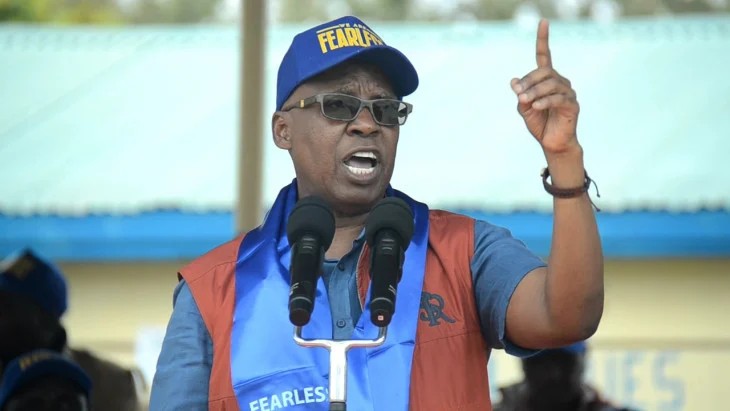
Safina Party leader Jimi Wanjigi has sharply criticized Treasury Cabinet Secretary John Mbadi for defending a corrupt system, labeling it as ‘mafia mandarins in the Treasury.’ This comment escalated the ongoing debate about Kenya’s public debt during a televised interview on June 20, 2026.
Wanjigi refuted Mbadi’s claim that he suggested Kenya should default on its debt, clarifying that he opposes payment on what he considers ‘illegal debt.’ “I never said we would default; I stated we won’t pay illegal debt. That’s a crucial distinction,” he emphasized.
Kenya’s public debt currently stands at approximately Ksh 13 trillion, with projections indicating it could rise to Ksh 14 trillion next financial year due to plans to borrow an additional Ksh 1.1 trillion. Wanjigi believes the legitimacy of the debt is the real concern, asserting that around 90% is illegal.
He pointed out that despite spending nearly Ksh 10 trillion on debt repayment over the past 13 to 14 years, the total debt keeps increasing. “How can our debt continue to climb with such significant repayments?” he questioned.
Wanjigi warned that without change, Kenya will remain trapped in a debt cycle for decades, predicting debt servicing will dominate the national budget through 2040. “This year, it’s Ksh 2.4 trillion; next year, Ksh 2.6 trillion, then Ksh 2.8 trillion. It won’t stop,” he stated.
He criticized the Treasury for normalizing excessive borrowing, making debt servicing the largest single budget item. “There’s no expenditure like it,” he noted.
Wanjigi also lashed out at Mbadi for failing to fulfill promises of auditing Kenya’s public debt, highlighting that such an audit was part of earlier political agreements that have yet to be realized. “Why hasn’t the audit happened? It was promised by William Ruto long ago,” he remarked.
He accused Mbadi of merely being a spokesperson for entrenched interests within the Treasury, urging him to step out of that role.
Wanjigi connected the current debt structure to past legal changes, particularly the 2014 amendments under the Public Finance Management framework, which weakened oversight. He pointed to past leaders like Aden Duale, whose decisions influenced today’s debt landscape.
He also questioned Mbadi’s commitment, noting that he previously supported debt audits and lower taxes but hasn’t acted on those positions. Wanjigi argued that assessing debt sustainability solely through debt-to-GDP ratios obscures the real burden on taxpayers.
He compared Kenya’s situation to countries like Japan and the United States, where debt is managed differently, allowing for more sustainable repayment structures. Unlike Japan, where debt is largely held domestically, Kenya allocates a significant portion of its revenue directly to servicing debt, limiting funds for development, health, education, and infrastructure.
As Kenya prepares for a Ksh 4.8 trillion budget backed by the recently passed Finance Bill 2026, Wanjigi cautioned that rising taxes and borrowing will only add strain on households already grappling with high living costs. Despite opposition concerns, the Finance Bill passed Parliament with 122 votes to 40.
While the Treasury argues that borrowing fuels development and stabilizes the economy, Wanjigi insists that only a full, independent audit of public debt can ensure transparency and accountability. He stresses the need to clarify what debt is legitimate before taking on more obligations; otherwise, Kenya risks remaining caught in a cycle of borrowing and pressure for years to come.


