

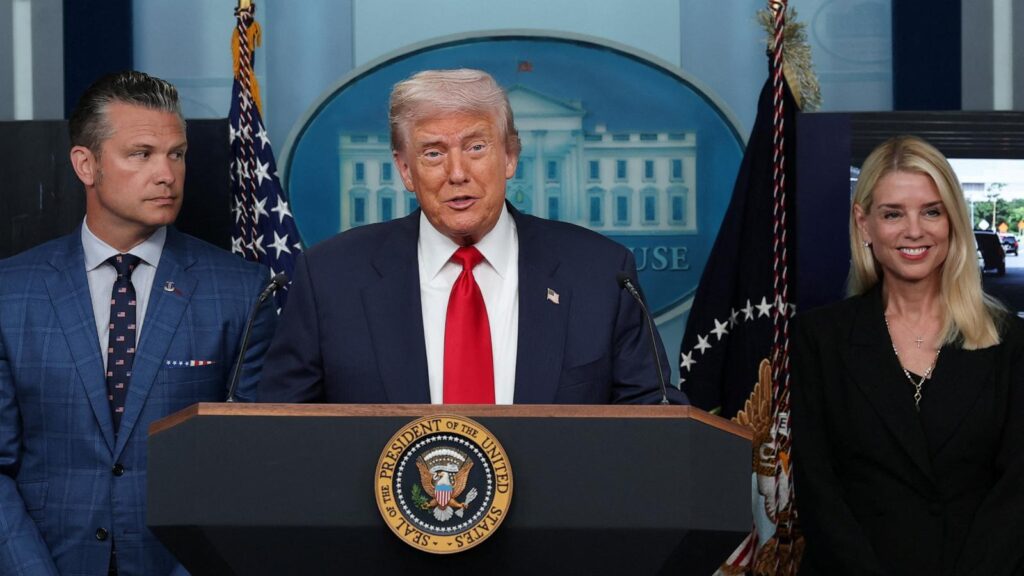
The President of the United States, Donald Trump, on Thursday delivered an unusually long and forceful press conference at the White House, outlining what he described as a major U.S. military and law-enforcement operation in Caracas that resulted in the capture of Venezuelan leader Nicolás Maduro and his wife, Cilia Flores.
According to the President, the operation—carried out in the early hours of January 2—was the culmination of months of intelligence gathering and inter-agency coordination involving the U.S. military, the Department of Justice, and multiple intelligence agencies. Trump said the mission was designed to apprehend Maduro, who was indicted in the United States in 2020 on charges related to narcotics trafficking and narco-terrorism.
Trump described the raid as “precise, overwhelming, and flawlessly executed,” asserting that no American service members were killed and no U.S. military equipment was lost. He praised U.S. forces for what he called a demonstration of American military superiority, comparing the operation to past U.S. actions against figures such as Qasem Soleimani and Abu Bakr al-Baghdadi.
Senior defense officials present at the briefing provided operational details, saying the mission involved air, sea, space, cyber, and intelligence assets, with more than 150 aircraft operating from multiple bases across the Western Hemisphere. Helicopters reportedly came under fire during the extraction but returned safely. U.S. officials said Maduro and Flores surrendered and were taken into custody before being transferred to a U.S. naval vessel for onward movement to the United States, where they are expected to face trial, potentially in New York.
The President reiterated that the United States does not recognize Maduro as Venezuela’s legitimate leader, noting that his legitimacy has also been rejected by the European Union and several other governments. Trump accused Maduro of running a vast criminal network responsible for trafficking drugs into the United States and sending violent gangs abroad, allegations that mirror claims made in U.S. indictments.
One of the most striking aspects of the press conference was Trump’s assertion that the United States would temporarily oversee Venezuela’s governance. “We are there now,” he said, adding that Washington would remain involved until a “safe, proper, and judicious transition” could take place. He emphasized that the goal was to prevent another authoritarian figure from assuming power and to stabilize the country before future elections.
Trump said U.S. officials, including Secretary of State Marco Rubio and Secretary of Defense Pete Hegseth, would play key roles in coordinating the transition with Venezuelan institutions and international partners. However, he offered limited clarity on the exact administrative structure or duration of U.S. involvement.
Energy policy featured prominently in the President’s remarks. Trump argued that Venezuela’s oil sector had collapsed due to mismanagement and corruption and announced plans for major U.S. oil companies to invest billions of dollars to rehabilitate infrastructure. He said revenue from renewed oil production would be used to rebuild the country, compensate those displaced by the crisis, and reimburse the United States for what he described as past expropriation of American assets.
The President also warned that U.S. military forces remain on high alert in the region and that all options remain available should security deteriorate. He said the operation sent a clear message to criminal networks, hostile governments, and political elites across the Western Hemisphere that the United States would act decisively against threats to its security.
Questions from reporters focused on the legality, risks, and historical precedent of U.S. involvement in regime change and post-conflict administration. Trump dismissed comparisons to past interventions, arguing that previous failures were the result of weak leadership. He maintained that his administration had a “perfect record of winning” and insisted that Venezuela would benefit from U.S. involvement.
Addressing the Venezuelan people directly, Trump promised peace, safety, and economic recovery, saying their country had once been prosperous and could be so again. “You’re going to have a real country,” he said, adding that Venezuelans living abroad would also benefit from stability and reconstruction at home.
While the White House framed the operation as a law-enforcement action supported by the military, the President’s statements about running Venezuela, rebuilding its oil sector, and maintaining an open-ended presence raised significant questions about the future of U.S. policy in Latin America. Analysts are likely to scrutinize the implications for international law, regional stability, and relations with countries such as Russia, China, and Iran, all of which have had interests in Venezuela.
As of Thursday afternoon, U.S. officials said further details on governance arrangements and timelines for elections would be announced in the coming days.


