

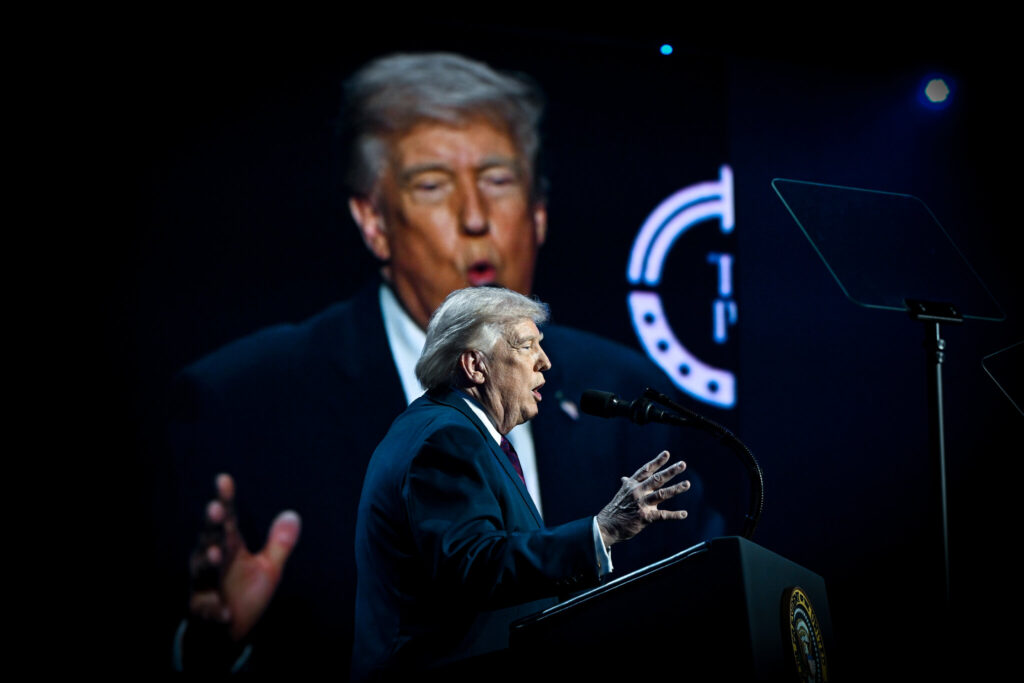
U.S. President Donald Trump announced that the United States will maintain its blockade on Iranian ports until a comprehensive agreement is established with Tehran. This declaration comes amid ongoing ambiguity regarding the possibility of renewed negotiations aimed at resolving the conflict.
The blockade, initiated a week ago, has severely impacted Iran, as Trump emphasized in a post on his social media platform, Truth Social, asserting that the U.S. is achieving significant success in the conflict.
As the temporary ceasefire between the U.S. and Iran approaches its conclusion on Wednesday, uncertainty looms over the likelihood of a second round of peace talks in Pakistan. Security measures have intensified in Islamabad in anticipation of the meeting. However, U.S. Vice President JD Vance, who is set to head the U.S. delegation, has yet to depart from Washington, and Iran remains undecided about its participation.
Since the blockade’s implementation, U.S. forces have redirected 27 vessels to either turn back or return to an Iranian port, according to the U.S. Central Command (Centcom). Additionally, U.S. forces intercepted and seized an Iranian-flagged cargo ship attempting to breach the blockade last Sunday, marking a significant escalation in the conflict. Centcom released videos purportedly showing troops warning the vessel before boarding.
Tehran has condemned this action as an “act of piracy” and a breach of the fragile ceasefire agreement. For nearly two months, Iran has enforced its own blockade on the Strait of Hormuz, a critical shipping lane, which has driven global energy prices upwards. Although the strait briefly reopened on Saturday, it was swiftly closed again following reports of vessels being targeted by Iranian forces.
Trump criticized Iran for allegedly “firing bullets,” characterizing it as a “total violation” of the ceasefire. Iran has stated it will keep the Strait of Hormuz closed until the U.S. lifts its blockade.
Despite Iran’s hesitance to confirm its participation, indications suggest that a second round of negotiations may proceed. Following the initial talks earlier this month, Vice President Vance remarked that the U.S. had not reached a consensus on terms acceptable to Iran. In response, Iran’s foreign ministry urged the U.S. to avoid making excessive demands.
The prospect of the second round of talks is critical, as sources informed the BBC that the U.S. delegation would depart “soon,” although no specific timeline was provided. An Iranian foreign ministry spokesperson indicated that, “so far,” Tehran had “no plans” to attend.
Vance is expected to be accompanied by special envoy Steve Witkoff and Jared Kushner, Trump’s son-in-law and advisor, as he was during the previous discussions. The identity of any Iranian representatives remains uncertain.
Preparations for the talks are underway in Islamabad, with guests at the Serena Hotel, the venue for the earlier discussions, instructed to vacate in anticipation of meetings. Police have also announced the closure of key roads due to the arrival of foreign delegations. A senior government official expressed confidence that Pakistan could facilitate Iran’s attendance.
In an interview with BBC’s Radio 4, Chief International Correspondent Lyse Doucet, reporting from Tehran, noted that while the situation remains unpredictable, the likelihood of the talks proceeding seems more favorable. She emphasized the diplomatic principle that parties generally seek to avoid blame for any breakdown in negotiations. With Vice President Vance’s presence in Islamabad, it would be challenging for Iranian officials to abstain from attending. Doucet suggested that intensive communication between Pakistani officials and both sides is underway, as they prepare for the imminent arrival of negotiation teams.


