

The government is taking deliberate steps to strengthen the country’s pharmaceutical ecosystem, President William Ruto has said.
The President explained that the government is enhancing the capacity of the National Regulatory Authority to achieve World Health Organisation Maturity Level 3.
He said this will reinforce global confidence in the quality, safety, and efficacy of Kenyan-manufactured products.
“Our ambition is clear: to position Kenya as a regional hub for pharmaceutical manufacturing, health innovation, and medical supply chains. And this journey is already underway,” he said.
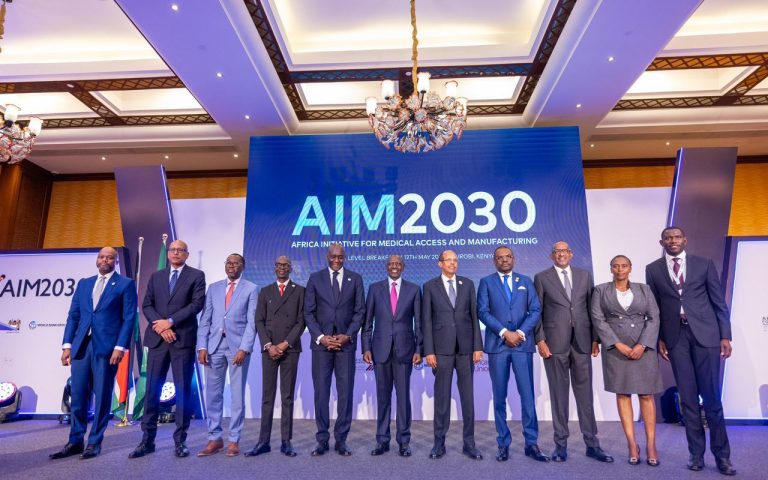
The President spoke during the Africa Initiative for Medical Access and Manufacturing (AIM2030) high-level meeting at the Africa Forward Summit at KICC, Nairobi.
Present were Managing Director and Executive Vice President of the International Finance Corporation (IFC) Makhtar Diop, African Union Commission Chairperson Mahmoud Ali Youssouf, WHO Regional Director for Africa Mohamed Yakub Janabi, and Health Cabinet Secretary Aden Duale.
The President noted that Kenya’s ambition in manufacturing is reinforced by the country’s strategic position as the gateway to East Africa’s fast-growing economic bloc, supported by a strong and expanding domestic market, world-class logistics, and a dynamic investment environment.
The President said Africa’s pharmaceutical market presents immense industrial opportunities, noting that the industry stood at approximately $30 billion in 2024 and is projected to reach $50 billion by 2030.
“By 2030, it is projected to exceed $50 billion. This is not only a health imperative. It is one of the most compelling industrial opportunities of our time,” he said.
He, however, noted that across the continent, nearly 700 pharmaceutical manufacturers exist, yet most remain small to mid-sized, fragmented, and concentrated in only a handful of countries.
“This limits scale, competitiveness, resilience, and our ability to respond effectively to future crises,” he noted.
The President called on African governments to implement Africa’s commitments on regulatory harmonisation, market integration, and industrial policy so that the continent can unlock its manufacturing potential.
“Now, here in Nairobi, we move decisively from ambition to execution, from commitments to bankable projects, and from dialogue to delivery,” he said.
He explained that the continent continues to face persistent structural barriers: fragmented regulatory systems, limited market integration, inadequate infrastructure, skills gaps, and insufficient demand certainty, all of which deter large-scale private investment.
He further urged development partners and implementing institutions to move with urgency to structure and finance scalable, bankable projects capable of delivering results at speed and at scale.
The Head of State also asked the private sector to leverage Africa’s market of nearly 1.6 billion people and a rapidly growing demand for health products.
“This is your moment to invest, to scale production, and to anchor long-term partnerships on the continent,” he added.
“Africa has the science. Africa has the workforce. Africa has the market. And Africa has the will,” he said.
Mr Youssouf noted there was a need to address the issue of health funding, saying sources of funding are becoming limited.
He called for the development of African-led pharmaceutical manufacturing to address the continent’s health needs.
Mr Janabi noted that the emergence of the hunter virus is a reminder that health threats do not wait, respect borders, and expose the fragility of the continent’s health systems.
He said that Africa is rewriting its narrative from dependency to determination, vulnerability to resilience, and from promise to performance.
“But this time Africa is not standing still. Africa is moving forward boldly and decisively,” he said.
Mr Diop noted that the World Bank Group’s AIM2030 seeks to double pharmaceutical manufacturing by 2030.
He said the continent should not wait for a crisis to build a resilient system because when it happens, it will be too late.


