

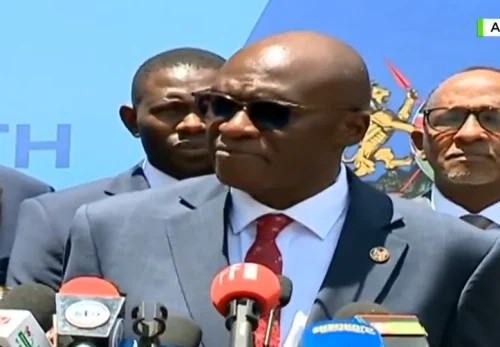
Public Health Director-General Dr. Patrick Amoth has shared insights on the government’s decision to withhold further details about Kenya’s first reported Ebola patient. He emphasized the importance of respecting the patient’s right to privacy and confidentiality.
Dr. Amoth stated that health authorities can only share additional information with the consent of the deceased patient’s immediate family. During a television interview on October 6, 2026, he confirmed that Kenya had recorded its first imported case of Ebola Bundibugyo virus disease.
The patient, a Kenyan citizen who traveled from the Democratic Republic of Congo (DRC) via Uganda, sadly passed away on October 5, 2026, after being admitted and isolated at Nairobi Hospital.
When asked about the lack of disclosure regarding the patient’s identity, Dr. Amoth reiterated the government’s commitment to privacy. “The patient has a right to privacy and confidentiality,” he affirmed.
He further explained that any information release would require permission from the family’s immediate members, which has not yet been granted.
As health authorities continue to trace individuals who may have had contact with the deceased, they are taking proactive measures to prevent further transmission of the virus.
Health Cabinet Secretary Aden Duale announced that 28 contacts, including family members and healthcare workers, have been identified and are currently being monitored. Additionally, authorities are tracking 23 passengers and four crew members from the same Jambojet flight as the patient.
Duale confirmed that arrangements are in place to quarantine those deemed at risk, as the government intensifies its response. Dr. Amoth mentioned that individuals suspected of contact with the deceased will be monitored for 21 days, with those showing any symptoms undergoing further assessment and testing.
The government’s focus has now shifted to contact tracing, monitoring, and containment in light of the confirmed imported case.
According to Duale, the patient had been living and working in the DRC for seven years and had reportedly experienced illness for about a month prior to traveling to Kenya. After a road journey from the DRC to Kampala, the patient boarded Jambojet flight 8523 to Nairobi, arriving at Jomo Kenyatta International Airport (JKIA) on October 3, 2026, around 1 PM.
Upon arrival, the patient underwent routine public health screening before proceeding through immigration. A relative and a friend transported the patient directly from JKIA to Nairobi Hospital, where isolation measures were promptly implemented.
Dr. Amoth previously noted that the patient’s treatment prior to traveling might have impacted the effectiveness of screening at the entry point, as some medications can temporarily mask symptoms like fever, complicating thermal screening efforts.
In response to this situation, Kenya is enhancing surveillance and contact tracing as health authorities diligently monitor individuals linked to the country’s first reported imported case of Ebola Bundibugyo.


