
Julius Malema, the leader of South Africa’s Economic Freedom Fighters (EFF), has received a five-year prison sentence for unlawfully possessing a firearm and firing it in public. This development raises significant questions about his political future.
At 45, Malema has established himself as a vocal critic of what he perceives as “Western imperialism.” He advocates for the nationalization of white-owned land in South Africa to rectify the historical injustices of colonialism and apartheid. This stance has garnered him substantial support, particularly among the disillusioned youth of South Africa. However, his political journey has also been marked by controversy, alienating various groups, including women’s rights advocates, white farmers, and even members of his own party.
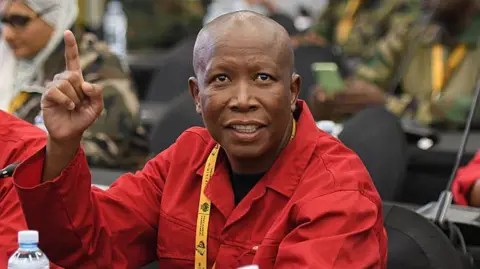
The EFF, commonly known as the red berets, is recognized for its trademark red overalls worn by party leaders in Parliament, symbolizing their connection to the working class. Malema has faced multiple convictions for hate speech and has been denied entry to the UK twice in the past year.
Despite his conviction, Malema will not serve time in prison immediately. He was found guilty of five offenses, including unlawful firearm possession and reckless endangerment, resulting in a five-year sentence. During his trial in KuGompo City, previously known as East London, he claimed he discharged the firearm in celebration. While he has the right to appeal the sentence, the conviction remains intact until the appeals process concludes.
Malema’s legal team plans to challenge both the conviction and the sentence. Legal expert Ulrich Roux explained that to contest his conviction, Malema must first seek permission from the Eastern Cape High Court. If granted, he can aim to overturn both the conviction and the sentence, though the state is expected to oppose this application.
Malema has committed to pursuing this legal battle up to South Africa’s Constitutional Court if necessary. Roux indicated that such a process could extend over four to five years.
As for his role as a Member of Parliament (MP), Malema can continue in his position. South African law stipulates that individuals sentenced to more than 12 months in prison without the option of a fine cannot serve as MPs. However, the constitution considers a sentence final only after the appeal process is completed, which could take years. Moreover, disqualification from serving as an MP would only occur five years after the sentence is fully served.
Political analyst Sandile Swana noted that the prolonged appeals process might allow Malema to stand for re-election in 2029. Even if his appeal fails and he faces disqualification, a political comeback remains a possibility, as demonstrated by former President Jacob Zuma, who, despite serving a 15-month sentence, formed a new party that performed well in the 2024 elections.
Analyst Khanyi Magubane expressed that this sentence could inadvertently bolster Malema’s political career, suggesting it might serve as a “trump card” in his election campaign. She believes it will position both Malema and the EFF favorably, allowing him to leverage public sympathy while maintaining his stance.
Malema aims to revitalize his party’s fortunes following recent setbacks, including losing votes to Zuma’s party and the departure of several key leaders, including party co-founder and his deputy, Floyd Shivambu.