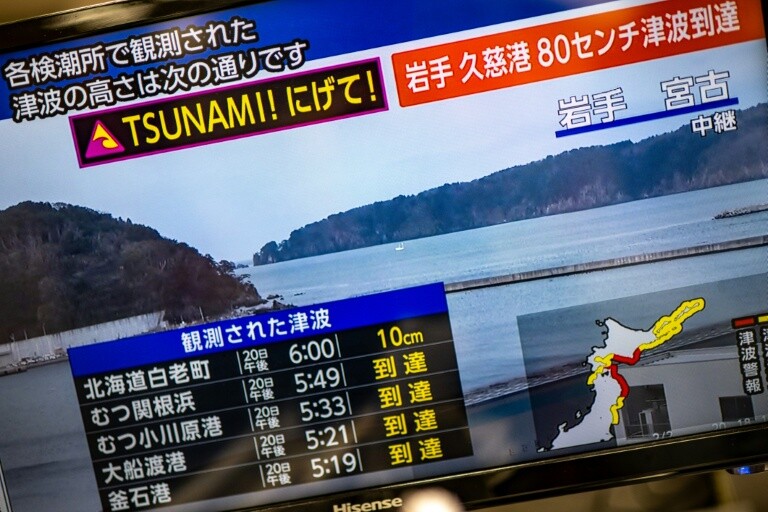
Officials in Japan have issued a warning about an elevated risk of a significant earthquake in the coming week following a powerful 7.7 magnitude quake that struck off the northeast coast. This seismic event prompted evacuation orders and raised concerns about potential tsunami waves reaching heights of 3 meters.
Thousands of residents received directives to evacuate coastal areas and seek higher ground after the quake occurred in the waters off Iwate Prefecture, located 530 kilometers (330 miles) north of Tokyo.
Although the largest waves measured 80 centimeters, Japan’s meteorological agency cautioned that stronger earthquakes could occur within the next week, potentially generating larger waves.
The agency further indicated that the likelihood of a quake measuring 8.0 or higher is now significantly elevated compared to usual conditions.
The memories of the catastrophic 2011 earthquake, which triggered a tsunami that claimed over 18,000 lives and caused a meltdown at the Fukushima nuclear power plant, continue to haunt the Japanese populace.
Following Monday’s undersea quake, recorded at a depth of 10 kilometers, authorities issued warnings of possible larger waves to residents in proximity to the epicenter, particularly in Honshu and the northern region of Hokkaido.
Tremors were felt as far away as Tokyo.
In Hokkaido, tsunami alerts remained active for two hours after the quake struck at 4:52 PM local time (08:52 BST).
Chaw Su Thwe, a Myanmar national residing in Hokkaido, recounted her experience: “As soon as we heard the earthquake alert, everyone ran downstairs. However, this time, the shaking was relatively mild.” She added, “Local authorities are using loudspeakers to inform residents about the potential tsunami and to remain vigilant. Office workers have been permitted to leave work early.”
Japan’s Cabinet Secretary Minoru Kihara reported that several bullet trains were disrupted and about 100 homes lost power. Fortunately, there have been no immediate reports of major damage or injuries.
A tsunami warning was issued along parts of Japan’s east coast, classified as the second-highest of three alert levels. Residents were instructed to evacuate immediately from coastal and riverside areas, relocating to higher ground or designated evacuation buildings.
“Tsunami waves are expected to strike repeatedly. Do not leave safe ground until the warning is lifted,” the Japan Meteorological Agency (JMA) urged in the hours following the quake. This plea was echoed by Prime Minister Sanae Takaichi, who emphasized the importance of seeking “higher, safer places.”
The tsunami warning was later downgraded to an alert status.
Japan’s location on the Ring of Fire exposes it to approximately 1,500 earthquakes annually, accounting for 10% of global quakes measuring 6.0 or higher.
The 9.0-magnitude earthquake that struck off the coast near Iwate province in March 2011 remains the most powerful earthquake ever recorded in Japan. The subsequent Fukushima meltdown stands as one of the worst nuclear disasters in history, prompting the government to regularly issue warnings and advisories to encourage residents to seek higher ground.