
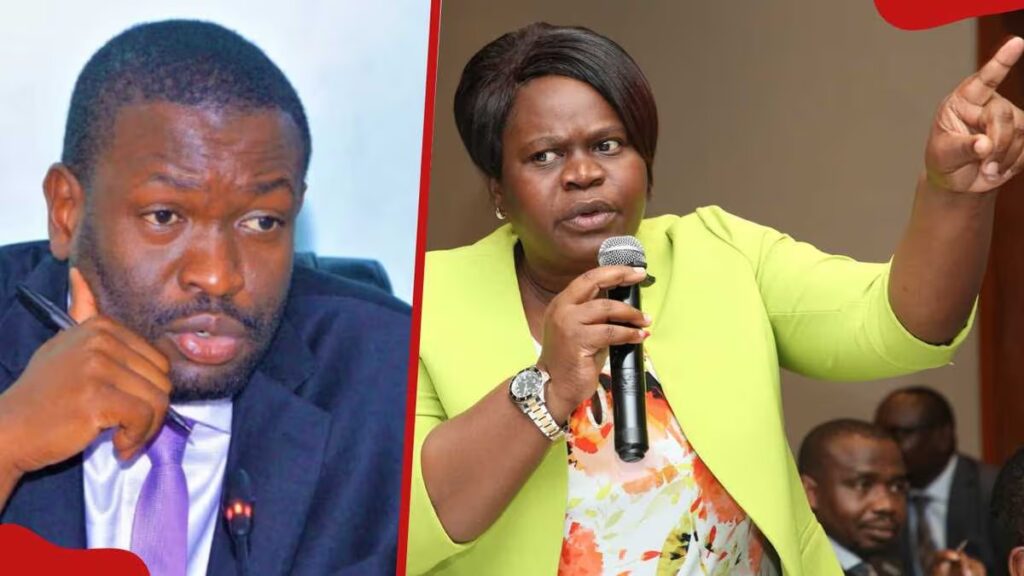
Gladys Wanga, chairperson of the Orange Democratic Movement (ODM), has criticized Nairobi Senator Edwin Sifuna for his contradictory statements regarding the appointment of Oburu Odinga as the party’s leader.
In an interview with a local television station on March 25, 2026, Wanga pointed out that Sifuna chaired the National Governing Council (NGC) meeting in Mombasa, which endorsed Oburu’s leadership following the death of party leader Raila Odinga.
Wanga stated, “During the NGC meeting that confirmed Dr. Oburu’s leadership, Edwin Sifuna conducted the session in Mombasa, overseeing the swearing-in and all related proceedings.” She added that Sifuna’s subsequent public comments questioning Oburu’s legitimacy undermined the organization’s direction. “When he appeared on national television claiming that Dr. Oburu is illegitimately in office, he delegitimized the leader of our organization, leaving us without a clear path forward.”
Wanga further accused Sifuna of straying from the party’s official stance, despite his role as its spokesperson. “As the mouthpiece of the party, it is crucial to articulate the party’s position accurately. When you present an opposing view, your position becomes untenable. Many have asked why we have distanced ourselves from Sifuna; the truth is, we did not expel anyone. We simply stated that it is no longer feasible for him to represent us when our direction differs so significantly from his.”
Wanga clarified that the issue was not merely about Sifuna’s opposition to the president. “We could oppose the president while he supports him, but if the party decides on a stance, our spokesperson must convey that position, regardless of personal views. The president’s influence does not factor into this.”
Oburu’s appointment as acting leader of ODM emerged from a transition process initiated by Raila Odinga’s death in October 2025. The party’s internal structures, particularly the National Governing Council, acted to ensure continuity by appointing an interim leader.
The NGC meeting in Mombasa confirmed Oburu’s role as acting party leader, a decision supported by party resolutions and defended by senior officials. In response to criticism, Oburu asserted, “All party officials are serving legitimately, backed by resolutions from party organs.”
As Raila Odinga’s elder brother and a long-standing figure within ODM, Oburu has assumed the role of transitional leader, tasked with stabilizing the party during this sensitive period.
Conversely, Sifuna has publicly questioned the legality of Oburu’s appointment, arguing that certain decisions did not fully adhere to party procedures. His assertions, including claims that Oburu was “not duly elected,” have sparked significant backlash from within ODM and revealed deepening divisions.
Sifuna has also emphasized the need for broader consultation on major party decisions, advocating for a National Delegates Convention (NDC), the party’s highest decision-making body.
This ongoing dispute underscores a larger leadership struggle within ODM as it navigates the post-Raila landscape, with factions emerging around issues of legitimacy, direction, and political strategy. Wanga’s comments reflect a concerted effort by one faction to defend the legitimacy of Oburu’s appointment while countering internal dissent. She cautioned that undermining leadership decisions could jeopardize the party’s stability during a critical juncture.
Her statements contribute to the growing pressure on dissenting leaders to align with party resolutions, as calls for unity and stability resonate within one of Kenya’s most influential political entities.