
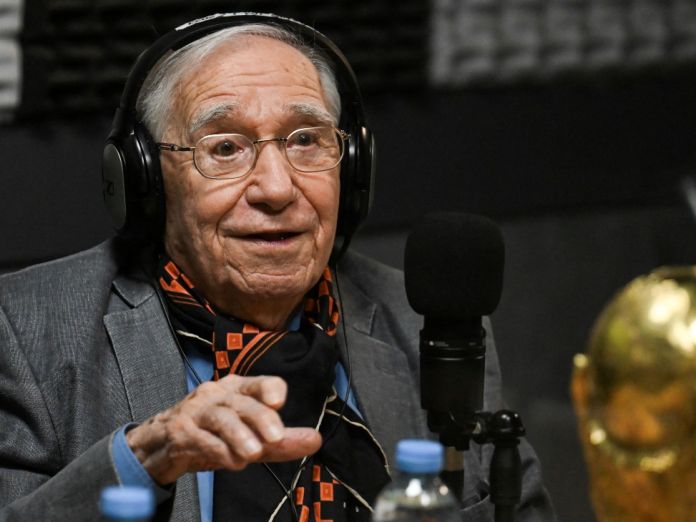
Everyone seems eager to capture a photograph with Enrique Macaya Marquez, and Argentina’s coach, Lionel Scaloni, is no exception. He took a moment to pose with the broadcaster after his press conference ahead of the World Cup group-stage match against Jordan.
Macaya, as he is affectionately known, boasts an incredible story. Over a remarkable career spanning nearly seven decades, the 91-year-old has covered an astounding 18 consecutive World Cups. His journey began in 1958, featuring a young prodigy named Pele at just 17 years old. At 24, Macaya traveled to Sweden for that tournament, where he witnessed Pele’s Brazil face Austria. However, his most vivid memory remains Argentina’s crushing 6-1 defeat to Czechoslovakia, a match he recalls as the ‘Disaster of Sweden.’
“It stands out in my mind as a devastating loss for the Argentine national team,” he reflects. “We had limited knowledge about Czechoslovakia, and they caught us off guard.”
Nearly seven decades later, Macaya has witnessed football evolve dramatically. He has reported on legends like Pele, Diego Maradona, and Lionel Messi, as television transitioned to digital, statistics became instantaneous, and World Cups transformed into global spectacles. Yet, one principle remains constant: Macaya approaches each situation with patience and understanding.
This philosophy shaped his perspective when Scaloni was unexpectedly appointed as Argentina’s manager in 2018. Initially, Macaya felt uncertain. “I didn’t have high hopes; I didn’t know him,” he admits. However, Scaloni has since led Argentina to triumph in the Copa America, Finalissima, and the World Cup, turning what many considered a significant gamble into one of football’s most remarkable success stories.
Watching these victories unfold reaffirmed Macaya’s long-held belief: “You can’t pass judgment without a deeper understanding of the person being evaluated.”
As Argentina prepares to face their historic rivals, England, in the World Cup semi-finals, Macaya remains optimistic about their chances of repeating their 2022 success. “Absolutely, they can win,” he asserts. “If we consider the possibilities for the future, I truly believe Argentina is capable of achieving greatness.”
When asked about his favorite Argentine player, there’s no hesitation. “Clearly, it’s Messi.” But when the conversation shifts to the greatest of all time, the certainty wavers. “That question deserves a smile,” he responds. “Measuring players across eras is nearly impossible. Times and opponents have changed. Each player is unique. I can share who I admire, but that doesn’t imply they are the best in history.”
This nuanced perspective explains why Macaya has maintained his respect over the years. He favors depth over definitive rankings, a sentiment echoed when he compares Messi to another legendary No. 10, Diego Maradona. “Making a straightforward comparison is challenging,” he notes. “The opponents, needs, and support from teammates varied greatly. Each had their unique path and story.”
He applies the same reasoning when contrasting Pele’s Brazil in 1970 with Maradona’s Argentina in 1986. “There’s no basis for comparison; their styles were entirely different.”
While it’s tempting to revel in victories, Macaya emphasizes the significance of defeats as well. “Many memorable matches exist, and negative results are equally a part of our history,” he states. For Argentinians, however, World Cup victories hold a cherished place. “Winning the World Cup stands among my favorite memories. In Maradona’s case, the trophy finally answered his lifelong quest to be a world champion.”
As for his own future, after nearly 70 years of covering the world’s biggest sporting event, retirement is on the horizon. “I will retire at some point,” he laughs. “I’m retiring now… so I’ll pause and revisit this later.”
For someone who has dedicated a lifetime to chronicling football history, this moment would serve as a fitting conclusion to an extraordinary career. True to his character, however, Macaya Marquez’s farewell will never feel entirely final.