
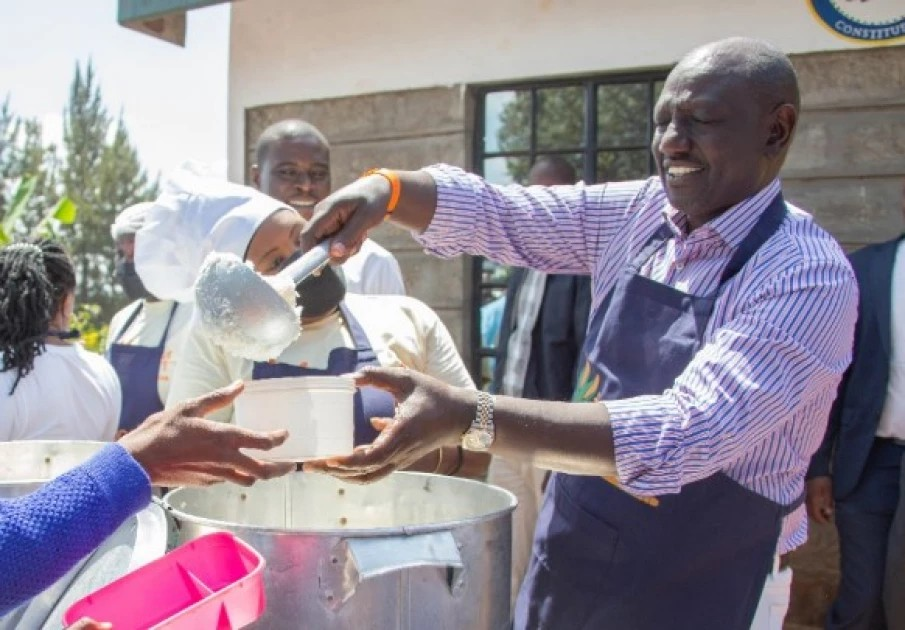
President William Ruto has announced an exciting national school meals program set to launch in all 47 counties during the first term of 2027.
This initiative aims to support learners in lower primary, upper primary, and junior secondary schools across the nation, reinforcing our commitment to social protection for families in need.
The President shared this vision on Tuesday through Labour and Social Protection Cabinet Secretary Alfred Mutua at the Fourth Kenya Social Protection Conference held at the Kenya School of Government in Kabete, Nairobi.
“Fragmented approaches to school feeding have limited our ability to make a significant impact. We need a sustainable solution that aligns with our national goals,” he stated.
“I am dedicated to establishing a comprehensive national schools needs program.”
While the President did not specify whether all schools would be part of this initiative, he emphasized the importance of collaboration.
“I urge the Ministry of Education to work alongside the Labour and Social Protection, the National Treasury, and other key stakeholders to develop the necessary policy, financing, governance, and implementation framework for our national rollout in 2027,” he added.
This commitment follows Health Cabinet Secretary Aden Duale’s announcement that Kenya is working to expand the school meals program from 2.6 million learners to 10 million by 2030.
Duale expressed this goal during a high-level meeting in New York, representing Ruto on child survival and nutrition.
The target of reaching 10 million learners by 2030 is a reaffirmation of a commitment made in 2024, now with a clear timeline for national implementation.
Currently, the government provides meals to approximately 2.6 million learners, focusing on vulnerable children in food-insecure areas.
An analysis from the Institute of Public Finance estimates that feeding 10 million learners at a cost of Sh20 per child per school day for 200 school days could require around Sh40 billion annually.
Kenya is also championing a home-grown school meals model, connecting schools with local farmers, ensuring that public funds spent on school food bolster local agriculture.
Additionally, Ruto announced plans to establish a Social Protection Fund to provide more predictable support for vulnerable Kenyans.
He highlighted the need for a system that protects families from poverty, disability, old age, and climate-related challenges.
“We must create a system that assures every Kenyan family that when tough times arise, the nation will stand by them,” he said.
“I commit to establishing and funding the Social Protection Fund, ensuring that benefits are predictable and expanding coverage to 2.5 million Kenyan households.”
The government also defended its progress under the Inua Jamii program, with Principal Secretary for Social Protection Joseph Motari reporting that the initiative has grown and improved how beneficiaries receive their funds.
“Currently, we provide Sh3.5 billion monthly to vulnerable Kenyans. By transitioning to mobile money, particularly M-Pesa, we’ve made payments faster and more accessible,” he explained.
The number of Inua Jamii beneficiaries has risen from 1.2 million to 1.7 million, adding 500,000 vulnerable Kenyans to the program.
The government aims to reach 2.5 million Kenyans.
CS Mutua addressed concerns about payment delays, stating that Ruto has mandated that if beneficiaries experience delays, his salary and those of ministers should also be withheld.
“The President of Kenya and government officials receive their salaries only after Inua Jamii recipients have been paid,” Mutua clarified. “Beneficiaries come first; the President is paid last.”
The three-day Kenya Social Protection Conference, running from September 29 to October 1, gathered around 500 delegates from government, development agencies, and other organizations. The theme, “Re-imagining Social Protection in an Evolving Socio-Economic Landscape and Climate Change,” focuses on strengthening adaptive, transformative, and sustainable social protection systems for inclusive development in Kenya.