
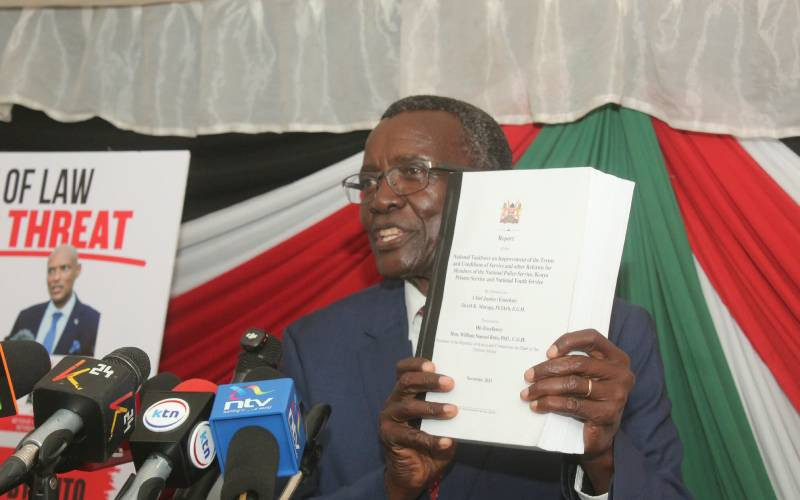
President William Ruto’s administration is currently under increased scrutiny regarding the pace and scope of police reforms, following the release of a report by former Chief Justice David Maraga. This document, delivered to Ruto in November 2023, has already influenced changes in officer pay, promotions, and human-resource management.
The report recommends comprehensive reforms for Kenya’s National Police Service (NPS), Prisons Service, and National Youth Service (NYS). Its recent publication has reignited a crucial political discussion: which reforms have been implemented, and which of the taskforce’s pivotal recommendations remain unaddressed?
The National Police Service Commission (NPSC) asserts that the government is progressively implementing the Maraga taskforce recommendations, highlighting salary reviews, promotions, and proposed amendments to the NPSC Act.
However, Maraga contends that the implementation has not achieved the structural changes necessary for establishing genuine independence within Kenya’s police service. He specifically critiques the legal framework surrounding senior police appointments, arguing that changes made in 2014 have heightened presidential influence over police leadership.
“The current Sections 13 and 30 of the National Police Service Act place deputies and the director under excessive presidential control. This is not reform; it is a form of capture,” Maraga stated.
This disagreement places additional pressure on the Ruto administration to clarify not only whether it has acted on the report but also which recommendations it prioritizes and why some of the key institutional proposals remain pending.
Ongoing Reforms
Evidence suggests that certain recommendations from the taskforce have progressed beyond mere proposals. In September 2024, the NPSC announced a salary increase for police constables, raising the entry-level basic salary from 21,645 Kenyan shillings ($167) to 25,645 shillings. Additionally, the commission reported promotions across various ranks, including 1,957 constables aged between 53 and 59 who had remained stagnant in their positions for over three decades.
The commission emphasized that salary reviews, promotions, and proposed legal amendments demonstrate progress in implementing the Maraga reforms. In May 2025, the NPSC informed a parliamentary committee that prioritizing the taskforce recommendations remained crucial, citing streamlined promotion and transfer processes, plans for digital recruitment, and enhanced mental-health support for officers.
As of February 2026, the commission was actively seeking funding to support the implementation of these reforms, indicating that budgetary assistance is essential for further advancements under the Maraga report.
These developments complicate any assertion that the report has been disregarded entirely.
Addressing Deeper Issues
However, the more pressing concern is whether the reforms undertaken adequately address the taskforce’s deeper issues regarding the organization, independence, and accountability of the police service.
The taskforce investigated various constraints affecting the National Police Service and identified leadership, corruption, underfunding, and human-resource management as significant challenges. Maraga argues that several critical recommendations remain unaddressed, including calls for the repeal of the 2014 amendments to key sections of the National Police Service Act and the establishment of competitive recruitment for senior police roles.
“The solution to this ongoing issue is straightforward. We must repeal the 2014 alterations to Sections 12, 13, and 30 and eliminate the misuse of Section 80(2) of the Public Service Commission Act,” he asserted. “We need to restore competitive recruitment for the Inspector General, Deputy Inspector General, and the Director of Criminal Investigations.”
This argument shifts the focus from police welfare to political power dynamics. Maraga contends that if senior police leadership remains susceptible to executive influence, improvements in salaries, promotions, and uniforms alone cannot constitute comprehensive police reform.
The government has not publicly acknowledged Maraga’s description of the structure as “capture.” Instead, its agencies point to ongoing reforms and efforts to implement the taskforce’s recommendations.
Uniforms vs. Substantial Change
The debate has intensified following the government’s introduction of new police uniforms, leading opposition politicians to argue that visible changes are receiving more attention than essential institutional reforms.
Maraga has dismissed the notion that new uniforms reflect the core of the taskforce’s agenda. “While a change of uniform is important for officers, it was not the primary recommendation,” he stated.
Democratic Party leader Justin Muturi echoed this sentiment, emphasizing that police reform should prioritize professional conduct and human rights. “We want our officers to receive training on human rights, not just on uniforms,” he stated.
Wiper leader Kalonzo Musyoka has called for revisions to police training, especially regarding public demonstrations, while DAP-K leader Eugene Wamalwa has demanded complete implementation of the taskforce recommendations.
This dispute occurs against a broader backdrop of scrutiny surrounding police conduct in Kenya, including Maraga’s claims of deaths linked to police brutality. These figures should be treated as claims made by the former chief justice rather than verified statistics.
For the Ruto administration, the report’s publication presents a more specific political challenge than merely explaining why the document remained private for nearly three years.
A Test of Accountability
The government can highlight tangible changes since 2023, particularly in police salaries, promotions, and human-resource systems. The NPSC continues to describe the implementation process as ongoing rather than complete.
However, Maraga’s intervention shifts the focus to the recommendations concerning the distribution of power within the police service. Given that Ruto established the task force and received its report directly, his administration bears a heightened responsibility to clarify the status of its recommendations.
The political question now extends beyond why Maraga’s report was withheld; it also encompasses whether the reforms already enacted align with the transformative vision of the taskforce or if the government has opted for more manageable and visible changes while leaving the most politically sensitive issues of police leadership and institutional independence unresolved.
This pressing question now rests firmly before Ruto’s administration.