
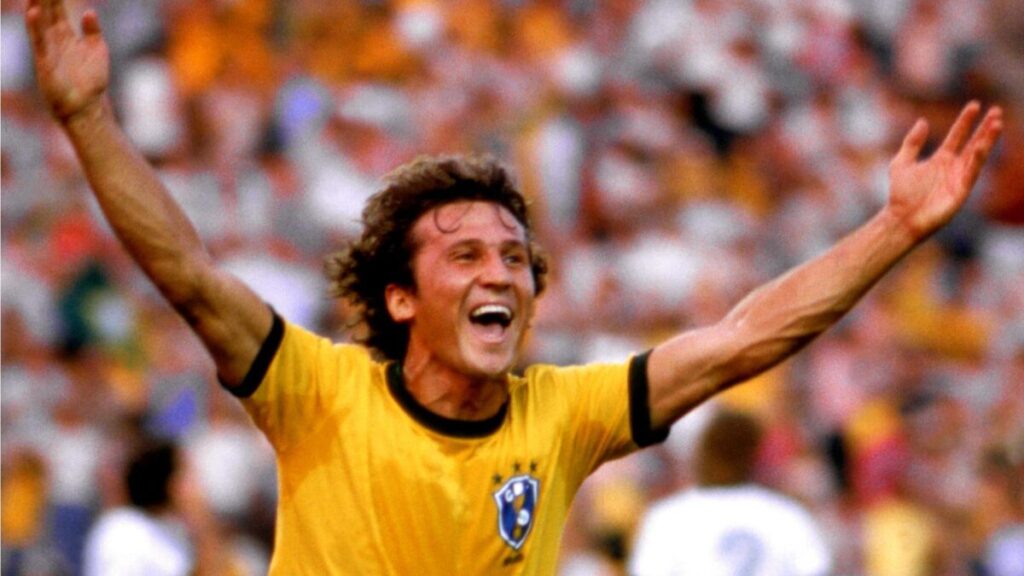
When discussing Brazil versus Japan, Zico inevitably comes to mind. This Brazilian legend, celebrated as a trailblazer in Japanese football, might feel a bit conflicted during such a match. However, he firmly states that when the teams take the field at the FIFA World Cup 2026 on Monday, he will simply be another enthusiastic fan of Brazil.
“I’ll be cheering for Brazil because I am Brazilian,” Zico shared with FIFA. “But if Japan wins, that’s fine too. What I can guarantee is that it will be an incredible match, as Japan excels in playing quality football.”
This upcoming match marks only the second occasion Brazil and Japan will meet on the World Cup stage. Their first encounter occurred two decades ago during the final matchday of the 2006 group stage, where Brazil triumphed with a 4-1 victory, and Zico was at the helm of the Japanese team.
“Of course, it was emotional,” he reflected. “Before the game, I told the players I would sing the Brazilian anthem, just like I learned in school. But the moment the match started, I was fully behind Japan. I couldn’t help but think of Didi, who won two World Cups with Brazil and once coached Peru against Brazil in 1970. It was a challenging experience.”
2006 was only Japan’s third World Cup appearance, but since their debut in 1998, they have consistently qualified for the tournament. This impressive record highlights the evolution of a footballing nation that is rapidly gaining strength and confidence to compete with the best.
“Japan has reached a higher competitive level now. Their players are moving to Europe, just like many Brazilian and South American stars. Out of the 26 players at the World Cup, 23 play in Europe, thriving in leagues like the Bundesliga, Serie A, and the Premier League,” Zico observed.
“Among the three players who remain in Japan, two are goalkeepers, and the other is Yuto Nagatomo, who serves as a leader and experienced presence in the squad. This marks his fifth World Cup.”
In the last two tournaments, Japan advanced to the knockout stages but fell short of reaching the quarter-finals. In 2018, they led their Round of 16 match 2-0 only to suffer a heartbreaking 3-2 defeat against Belgium. Four years later, they scored first against Croatia but ultimately lost in a penalty shootout.
Both times, their elimination prevented a potential matchup with Brazil, making their 2006 encounter with Zico the only World Cup clash so far.
“That could only happen to me, right?” Zico chuckled. “But those campaigns illustrate Japan’s remarkable progress. That’s the essence of the World Cup. Japan is ready to face anyone. In recent years, they’ve defeated Brazil, Germany, Spain, and England. They are truly prepared for whatever challenges arise.”
For Zico, the recent strides in Japanese football extend beyond mere technical skill. Their mental resilience in high-pressure situations has been pivotal, a quality he witnessed firsthand during his coaching tenure with the team.
“Certainly, the tactical improvement is evident, but the primary challenge for Japan has always been psychological. They now possess the ability to handle setbacks and respond effectively when they fall behind,” he noted.
“In 2006, for example, we needed to win by two goals to advance. We scored first, but conceded just before halftime. The current team has more experience; they would maintain possession and manage the game better. Back then, we struggled with that.
“Had we started the second half ahead, things might have unfolded differently, but Ronaldo scored a late header. And he has the audacity to call me his idol? The only header he ever scored was against me,” he laughed.
The coaching role for Japan, once held by Zico, is now filled by Hajime Moriyasu, a former player who faced Zico during his J.League career. Moriyasu took charge in July 2018 and led the team to historic group-stage victories over Spain and Germany at Qatar 2022. Despite a Round of 16 exit, he became the first Japanese coach to have his contract extended after a World Cup.
“I played against him in Japan, as well as his brother (Hiroshi Moriyasu). He showcased great technique and quality. He’s another midfielder who has transitioned into a fantastic coach,” Zico added.
The game also holds personal significance for Zico, as both Moriyasu and Brazil’s coach Carlo Ancelotti were his opponents during his playing career.
“I remember them both clearly. They were defensive midfielders. Thankfully, neither played dirty. They had excellent skills and a keen understanding of the game, which is why they continue to excel in their roles today.”