
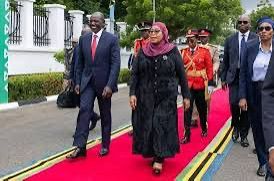
NAIROBI, Kenya – A simmering generational divide exploded into a fiery cross-border debate this week after Tanzanian President Samia Suluhu Hassan allegedly suggested to Kenyan President William Ruto that unruly youth should be beaten with a mkwaju (a traditional cane or whip). The proposal, made during a closed-door conversation that has since become public, has triggered a fierce backlash from Kenyan youth leaders, who accuse both Heads of State of contempt for a generation demanding accountability.
In a tense televised roundtable on Wednesday, youth representatives from across Kenya’s political spectrum rejected what they termed a “rogue” approach to governance, warning that the era of silencing young people with violence is over.
The controversy erupted following President Suluhu’s reported comments to President Ruto, where she allegedly proposed using physical discipline to manage Gen Z protesters. The remarks struck a raw nerve in Kenya, where at least two dozen protesters were killed during anti-finance bill demonstrations in June and July of last year.
“Mkwaju is not a solution; it is a declaration of war on consciousness,” said Angel Booty, Chairperson of the Jubilee Youth League. Booty argued that Tanzania has historically suppressed youth voices, noting that Dar es Salaam only recently established a National Youth Council—years after ratifying the African Union Youth Charter.
“Asking a government to be accountable is not disrespectful. Asking for transparency is not disrespectful. What is disrespect is leaders trying to talk down to us because we refuse to beg for our rights,” Booty said.
A Question of Silence
The sharpest criticism was reserved for President Ruto, who was seated beside his Tanzanian counterpart when the remarks were made.
“Silence means consent,” said Shakira Wafula, a youth leader. “If the President does not approve of such a statement, why did he not speak for the Kenyans who have been tortured across the border? Where was the Ministry of Foreign Affairs when Kenyans lost their lives during the disputed Tanzanian elections?”
Panelists pointed to the alleged deaths of over 3,000 people during Tanzania’s October 2020 election—a claim Tanzanian authorities have consistently denied—and the torture of Kenyan activists like Boniface Mwangi to argue that the proposed crackdown is already a reality.
Shofin J, National Youth League Chair, dismissed President Suluhu’s democratic credentials outright. “She came to power via a natural catastrophe, and her second term was so undemocratic she was sworn in at a military base. She has no moral authority to lecture us on discipline,” he said.
‘Understand the Context’
However, not all panelists agreed that President Ruto was at fault. Advocate Otieno Mokaya urged the public to view the comments through a diplomatic lens, arguing that what is said casually between peers is not binding policy.
“President Samia was speaking to her realities, not ours. We are a constitutional democracy. No foreign leader’s joke can override the Bill of Rights,” Mokaya said. He added that President Ruto’s silence should be interpreted as disagreement, and that Kenyans should focus on the eight bilateral trade agreements signed during the state visit—including railway and maritime deals—rather than a single inflammatory phrase.
Mark Ooko, coordinator of the National Students Council, echoed this sentiment, accusing critics of suffering from “negativity fatigue.” He insisted there is a “silent majority” of Gen Z Kenyans who prioritize stability and TikTok over street protests.
A United Regional Front
Despite those calls for moderation, the overwhelming sentiment from the panel was one of defiance. Youth leaders vowed to continue cross-border solidarity, arguing that the frustration expressed by President Suluhu proves that young East Africans are winning.
“She is frustrated because we have achieved regional solidarity that they cannot cope with,” said Shakira Wafula. “We are bringing our minds together around justice and free speech. If that scares them, then we are doing something right.”
As the debate shifts from diplomatic niceties to generational warfare, one thing was clear from the Nairobi roundtable: Kenyan Gen Zs have rejected the mkwaju proposal outright—and they are daring their leaders to try it.
“We are not unruly children,” said panelist Koster A. “We are parents, workers, and citizens. And we will go to Tanzania to seek justice for our own if we must. The time for begging for decency is over.”