
This year’s Saba Saba commemorations across Kenya took on a notably subdued tone, primarily due to extensive police presence and roadblocks that restricted access to city and town centers.
While these security measures aimed to ensure safety, they inadvertently caused significant traffic disruptions, bringing Nairobi to a near standstill for much of the day.
Motorists and commuters faced long delays as police set up barricades on major roads leading into Nairobi’s Central Business District (CBD), compelling many to seek alternative routes and resulting in lengthy walks to their workplaces.
The increased security presence effectively deterred the large crowds and demonstrations that typically characterize the annual commemoration of the pro-democracy movement from July 7, 1990.
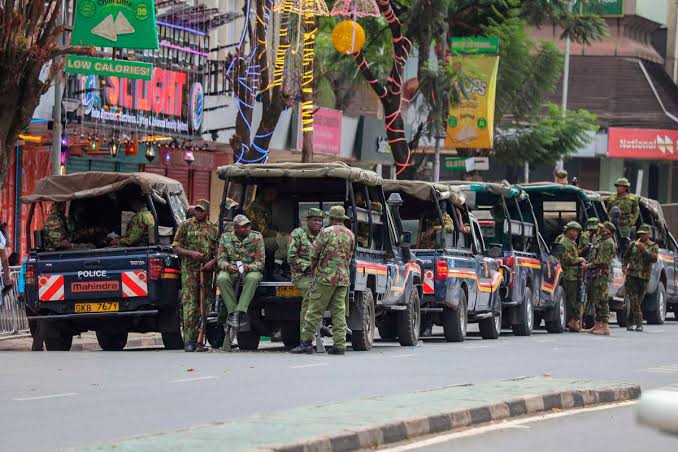
On Tuesday morning, sections of Nairobi’s CBD displayed minimal activity, with a heavy police presence dominating key streets and intersections in anticipation of the planned Saba Saba demonstrations.
By mid-morning, the CBD remained unusually quiet, with only a handful of private and public service vehicles navigating the typically busy streets.
Pedestrian traffic also saw a considerable decline, as many streets felt eerily calm compared to a normal working day.
A police lorry was stationed at the roundabout near the General Post Office (GPO) along Kenyatta Avenue, with officers strategically positioned throughout the CBD.
The usually bustling pavements and bus stages appeared sparsely populated, as many Nairobi residents opted to avoid the city center.
Movement into and out of the CBD remained limited by mid-morning, with relatively few vehicles accessing the area.
Public transport services also felt the impact, as fewer matatus operated routes into the CBD.
Police maintained that Tuesday’s demonstrations had not been lawfully notified, countering claims from organizers who asserted they had informed relevant security agencies in advance.
Nairobi Police Commander Issa Mohamud stated that the service became aware of the planned protests solely through social media.
“We have never received notifications; that is the accurate position. Thus, any violence, property destruction, looting, or attacks on police stations are criminal acts. We will deal firmly and decisively with all criminal elements within the law,” Mohamud assured.
He further reassured the business community and Nairobi residents that sufficient security measures had been implemented to protect lives and property.
“There will be controlled access. Movement will not be unrestricted. Certain areas, like Parliament, will have access limitations,” he added.
In Mombasa, a peaceful procession faced brief disruption when protesters clashed with security officers over the designated route through the Central Business District.
Tensions arose after police attempted to redirect the demonstrators, insisting they follow a different path, leading to a standoff between both parties.
Kisumu remained calm on Tuesday, with businesses operating as usual despite nationwide calls from activists to observe the annual Saba Saba demonstrations.
Unlike previous years, when the lakeside city experienced protests and heightened security, traders opened their shops, public service vehicles ran normally, and residents continued their daily activities without interruption.
In Eldoret, security teams patrolled the town in lorries and Land Rovers to monitor the situation and ensure businesses could operate smoothly.
Uasin Gishu County Police Commander Wilberforce Sicharani noted that they had not received any notifications regarding planned protests in Eldoret or surrounding areas.
“We are actively monitoring the situation across all regions to ensure business continues as usual throughout the county,” Sicharani stated.
Most security teams were deployed along the Eldoret-Webuye Road and the highway leading to Kisumu.
“While we do not anticipate any incidents, we remain alert to respond and maintain security as part of our mandate,” Sicharani added.
Despite the subdued observance on the streets, political leaders, civil society groups, and public figures marked the day through statements on social media and other platforms.
Several leaders encouraged Kenyans to uphold the principles of democracy, justice, and the rule of law, emphasizing the importance of remembering the sacrifices made by those who fought for multi-party democracy.
ODM Party leader Oburu Oginga advocated for a shift in perspective regarding the day, suggesting it should be transformed into a national holiday to honor the heroes of the multi-party democracy movement.
“Having experienced that struggle, I take pride that these milestones were achieved in the early ’90s and later enshrined in our 2010 Constitution. Since we have won these foundational battles, it’s time for Saba Saba to evolve. I truly believe it should be officially recognized as a national holiday,” Oburu expressed in a statement.
“Rather than resorting to conflict in the streets, let’s utilize this moment to appreciate our significant political gains, reflect on our future, and honor the brave heroes who fought for our freedom. Together, let’s safeguard our hard-earned democracy.”
Nairobi Senator Edwin Sifuna paid tribute to the victims of political intolerance while urging the government to respect citizens’ constitutional freedoms.
“On this Saba Saba, we celebrate all those who sacrificed in the struggle for democracy and the fight against human rights abuses and political repression,” Sifuna shared in a post.
“It’s disheartening that 36 years later, the threat of political violence still lingers. We mourn the loss of Vincent Osiemo, a victim of political violence in Keumbu last Friday—an unnecessary death stemming from intolerance. On behalf of the Linda Mwananchi team, we stand with his family and will continue to demand justice and accountability for those responsible.”
Saba Saba, commemorated each July 7, marks the anniversary of the historic 1990 demonstrations that propelled Kenya’s transition to multi-party democracy. This date remains a crucial milestone in the country’s ongoing struggle for political freedoms.