

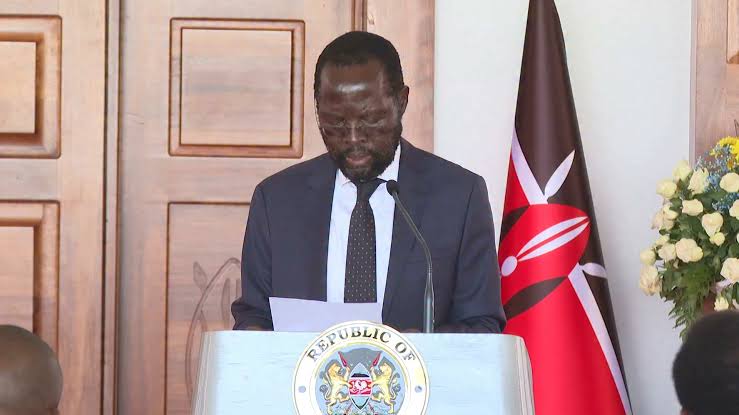
Kisumu Governor Prof. Anyang’ Nyong’o emphasizes the distinction between Kenya’s current development blueprint, Vision 2030, and the proposed Vision 2060. He clarifies that the new long-term plan is not simply a political initiative; rather, it represents a constitutional and national commitment aimed at guiding the country’s transformation beyond the present.
Having played a pivotal role in the creation of Vision 2030 in 2002, Nyong’o highlights that each vision addresses different historical contexts and planning requirements.
“Vision 2030 aims to enhance the quality of life for the people and improve their conditions, making it inherently beneficial to their interests. We must clearly communicate that Vision 2030 is not a mere campaign tactic,” Nyong’o asserts.
He points out that Vision 2030 was designed as a roadmap for improving the lives of Kenyans over a 30-year span, maintaining its status as a national agenda rather than a partisan one.
“Vision 2030 prioritizes the nation’s interests and outlines a strategy for uplifting the lives of the people over the next three decades. I have not observed anyone taking a partisan stance regarding Vision 2030. As we approach 2030, it is vital to look further ahead and plan for our future, hence the necessity of Vision 2060,” he explains.
Nyong’o’s statements arise amidst a burgeoning national dialogue following President William Ruto’s call for a nationwide discussion on Kenya’s future beyond Vision 2030. In a special address at State House, Nairobi, on July 30, 2026, President Ruto characterized this initiative as “the most significant national conversation since the adoption of our Constitution in 2010.”
He stressed the need for this discussion to “transcend politics, rise above electoral cycles, and unite us around a shared destiny.”
Acknowledging that Vision 2030 has shaped national development priorities for two decades, Ruto argued that Kenya now requires a new development framework rooted in the 2010 Constitution. He emphasized that this process should be driven by the people and include citizens from all walks of life.
Ruto also remarked that while Vision 2030 revolutionized the country’s approach to long-term planning, several of its goals, such as achieving upper-middle-income status by 2030, remain unmet. He urged the nation to view these challenges not as failures but as opportunities to learn and define the next phase of Kenya’s development.
Three Pillars of Vision 2060
Nyong’o describes the proposed Vision 2060 as broader in scope, anchored on three foundational pillars: political, economic, and social.
“Vision 2060 rests on these three pillars, which are essential for defining the national government’s responsibilities and for evaluating how public resources transform the country,” he states.
According to the governor, this new blueprint seeks to integrate governance, economic growth, and social welfare into a cohesive long-term framework that guides public policy beyond the terms of any individual administration.
He emphasizes that the new vision must prioritize citizens in the development process.
“Vision 2060 serves as a national blueprint that considers the economy, society, and the active role of citizens in driving the vision forward. Engagement is crucial; a vision cannot thrive without the involvement of the people,” Nyong’o asserts.
This focus on public participation aligns with President Ruto’s view that the new vision “cannot be crafted by politicians alone” and must emerge from “an open, inclusive, and honest national conversation” that encompasses farmers, workers, entrepreneurs, professionals, faith leaders, youth, and other citizens.
Constitutional Foundation
The emerging dialogue surrounding Vision 2060 is closely linked to the Constitution’s economic and social rights. In his address, Ruto referenced Article 43, which guarantees every Kenyan the right to health, housing, food, water, social security, and education, and argued that the next national vision must translate these rights into measurable development outcomes. He asserted that the purpose of state power extends beyond mere governance; it aims to expand opportunities, promote human dignity, create wealth, and enhance citizens’ lives.
Nyong’o echoes this sentiment, framing Vision 2060 as a mechanism for ensuring basic human welfare for future generations.
“A child born in 2060 should not face preventable diseases, should have unobstructed access to education, and should aspire to achieve their goals in life. Vision 2060 must foster an environment where everyone feels at home,” he emphasizes.
From Development Plan to National Charter
The governor highlights a key difference between the two visions: Vision 2030 primarily serves as a development roadmap, while Vision 2060 is envisioned as a comprehensive national charter that outlines the country’s long-term aspirations.
President Ruto similarly contends that Kenya’s next vision should not merely be “another government development plan” but a national development charter that translates constitutional ideals into practical realities, enduring beyond shifts in government. He asserts the need to establish standards for measuring progress and to build institutions capable of sustaining long-term transformation.
The president revealed that he invited Prof. Hiroyuki Hino, Prof. Anyang’ Nyong’o, and other scholars to draft strategic guidelines for Kenya’s future beyond Vision 2030, with their proposals forming the foundation for the upcoming national conversation. He stated that with disciplined execution and commitment to long-term transformation, Kenya could become a prosperous, high-income, industrialized, and globally competitive nation within a generation.
Looking Beyond 2030
Nyong’o asserts that planning beyond 2030 is not merely optional; it is essential, as national development is an ongoing journey.
He encourages the debate to focus less on political affiliations and more on the type of future that generations to come will inherit.
The government plans to officially launch the National Conversation on Kenya’s Future Beyond Vision 2030 on August 12, 2026, convening political leaders, business groups, labor organizations, faith communities, universities, professional associations, innovators, civil society, and youth from across the nation. Ruto has committed to ensuring this process is inclusive, transparent, and genuinely national, aiming to build a shared long-term vision for Kenya’s prosperity.
For Nyong’o, the ultimate measure of Vision 2060 will be its ability to create a nation where every Kenyan feels included and has a real opportunity to flourish.
“A child born in 2060 should not suffer from preventable diseases, should access education without barriers, and should be empowered to achieve their aspirations in life. Vision 2060 must create an environment where everyone feels at home,” he concludes.


