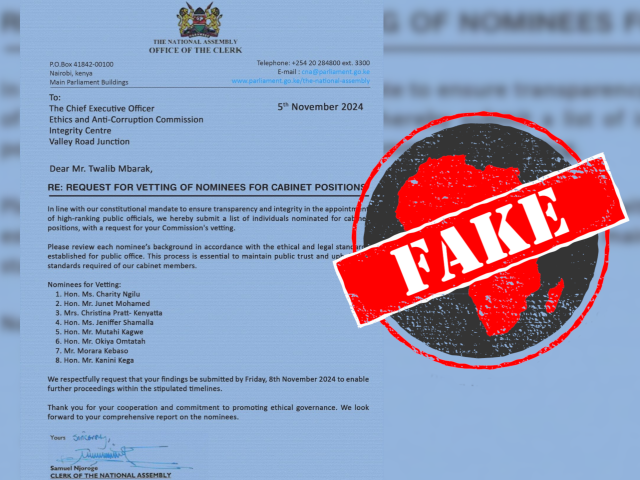
The Ethics and Anti-Corruption Commission (EACC) has officially denounced a fraudulent letter that falsely claims to seek integrity vetting for several individuals allegedly nominated for Cabinet positions.
In a clear statement shared across its official social media channels, the EACC distanced itself from this misleading document, which has circulated widely online.
The fabricated letter, dated July 23, falsely addressed EACC Chief Executive Officer Abdi Ahmed Mohamud and claimed to originate from the National Assembly. It inaccurately requested the commission to conduct integrity vetting on five individuals purportedly nominated for various Cabinet roles.
Among those named in this counterfeit document were Winnie Odinga, allegedly nominated for the Tourism and Wildlife docket; Junet Mohamed for Lands, Public Works, Housing, and Urban Development; and Koki Muli for Water, Sanitation, and Irrigation. The letter also mentioned Cleophas Malala for Agriculture and Livestock Development and Dr. Agnes Zani for Information, Communications, and the Digital Economy.
The letter falsely asserted that the vetting request aligned with the constitutional mandate to ensure transparency and integrity in appointing high-ranking public officials. It claimed that the commission had been requested to review each nominee’s background based on ethical and legal standards applicable to public office holders.
Additionally, the fraudulent correspondence directed the commission to submit its findings by Tuesday, July 28, to facilitate what it described as further proceedings within specified timelines. It concluded by thanking the commission for its cooperation and commitment to ethical governance, expressing anticipation for a comprehensive report on the purported nominees.
However, the EACC has categorically rejected this document, affirming that it is entirely non-genuine. The commission shared the letter prominently stamped with “FAKE,” clearly indicating that this document should not be considered official communication.
This clarification arrives amidst a rising trend of fabricated government documents circulating online, often featuring official logos, letterheads, and signatures to create a false sense of authenticity.
Such misleading documents can easily confuse the public, particularly when they falsely claim to communicate official government decisions or constitutional processes.
Integrity vetting of nominees for certain public offices is a recognized process within Kenya’s governance framework. When appropriate, institutions like the EACC may provide vital information regarding the suitability of nominees in accordance with the law.
The commission’s recent clarification emphasizes the crucial need to verify the authenticity of official documents before relying on or sharing them. By staying informed and cautious, we can collectively uphold the integrity of our governance systems.