

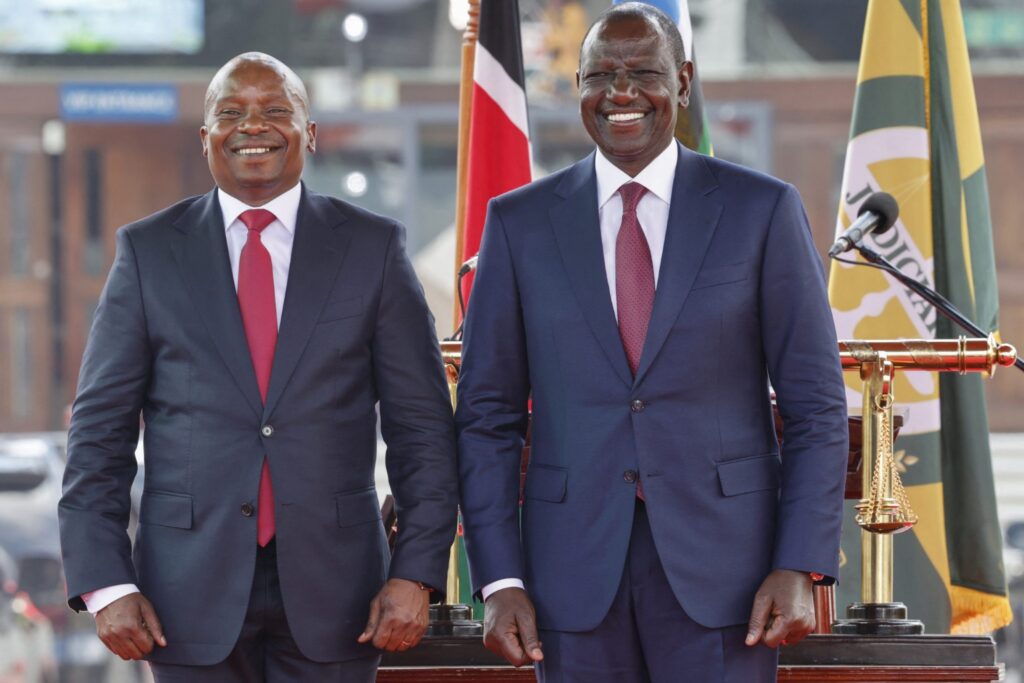
Deputy President Kithure Kindiki’s political challenges reflect a broader trend faced by many in similar positions throughout history.
History reveals that deputy presidents often navigate a complex choice: they must decide whether to maintain access to power or safeguard their future careers beyond the current administration.
Kindiki firmly asserts his intention to remain President William Ruto’s running mate in the 2027 elections. He has recently communicated to potential contenders for this role that they should reconsider, emphasizing that the “Ruto-Kindiki ticket” will indeed appear on the ballot.
Yet, the pressure surrounding him is intensifying. The ODM party has declared the deputy presidential position non-negotiable in any agreement with UDA for 2027, demanding an equal share of government responsibilities.
Prominent figures like Wycliffe Oparanya, Hassan Joho, and Gladys Wanga are being considered as potential running mates for Ruto.
Public Service Cabinet Secretary Geoffrey Ruku has also contributed to the uncertainty. While he supports Kindiki, he has indicated that Mt Kenya East would still back Ruto even if another running mate is chosen.
Reports from The Standard indicate that intergovernmental coordination responsibilities previously managed by Kindiki’s office have now been transferred to Prime Cabinet Secretary Musalia Mudavadi. While this shift does not remove Kindiki from his position, it fosters a perception that his political influence is diminishing.
Historical examples demonstrate how resignation can rejuvenate political careers.
In Zambia, Levy Mwanawasa resigned as vice-president in 1994 due to disagreements within Frederick Chiluba’s administration. Although he stepped back from frontline politics, he made a triumphant return as the ruling party’s presidential candidate in 2001, ultimately winning the presidency in January 2002.
Mwanawasa’s journey illustrates how stepping away from an unpopular administration can help a politician maintain an independent identity, paving the way for a successful comeback.
Kenya’s Jaramogi Oginga Odinga chose a different route. After resigning as vice-president in 1966 due to conflicts with President Jomo Kenyatta, he founded the Kenya People’s Union and became a prominent opposition figure. While he never attained the presidency, his political legacy endured long after his time in government.
In the United States, John C. Calhoun resigned as vice-president in 1832 following significant disagreements with President Andrew Jackson. He transitioned to the Senate, remaining a powerful national political figure. His career exemplifies how vacating a powerless deputy role can create space for a distinct political platform.
These cases do not guarantee success through resignation; rather, they illustrate that remaining in office isn’t always the sole path to political survival.
However, Kindiki faces unique challenges that complicate his situation.
Unlike Mwanawasa, who eventually secured a presidential position, or Jaramogi, who had a strong ideological base and established his own party, Kindiki currently lacks these advantages.
Gachagua’s DCP has shown electoral strength, as demonstrated by Sammy Kamau Ngotho’s impressive 35,440 votes in the Ol Kalou by-election, compared to UDA’s 5,450. This nearly 30,000-vote margin has weakened Kindiki’s argument that government and opposition forces are evenly matched in Mt Kenya.
Resigning immediately would leave Kindiki without his deputy presidency, control over UDA, or a solid political vehicle. According to Article 149 of the Constitution, a vacancy in the deputy president’s office would enable Ruto to nominate a replacement within 14 days, with the National Assembly voting on the nominee within 60 days. This scenario could allow Kindiki’s successor to solidify government connections ahead of the 2027 elections.
Gachagua has suggested that Ruto’s allies may be undermining Kindiki in hopes of prompting his resignation, although there is no public evidence to support claims that the President is orchestrating such a campaign.
Despite these challenges, Kindiki has compelling reasons to persevere. An Infotrack survey indicates that he enjoys a 34% preference as the ideal candidate to deputize Ruto. His current office provides him with visibility and direct access to government initiatives.
While resigning could offer Kindiki the freedom to cultivate an independent political career, it also poses the risk of ending his political journey prematurely. Remaining in his position safeguards his immediate power but also exposes him to potential political vulnerability if Ruto decides to exchange the running-mate slot for ODM’s support.


