
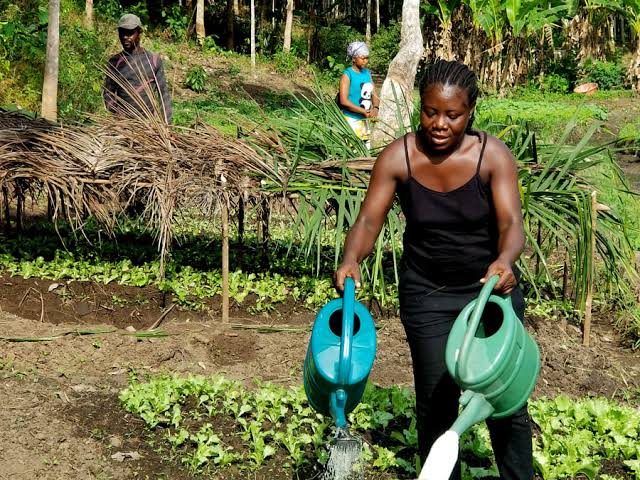
Under the bright sun in Uyoma, Rarieda, rows of lush kale sway gently in the breeze as Wilfrida Okech inspects her thriving crops.
A few years ago, the 33-year-old mother of two worked as a community social worker. Today, she has transformed farming into her primary source of income and a path to independence.
What began as a quarter-acre farm has evolved into a flourishing agribusiness that supports her family and provides opportunities for several young people and women in her community.
“I used to earn very little and often struggled to find a market for my produce. Now, farming is my main income source, allowing me to earn up to Sh50,000 a month,” she shares.
Wilfrida is among thousands of young people benefiting from the Resilient Agriculture that Works for Young People program, which Practical Action Kenya implements with support from the Mastercard Foundation.
This program operates across six subcounties in Siaya, focusing on helping young individuals build sustainable livelihoods through agriculture.
Melvin Otieno, a project officer with Practical Action Kenya, states that the program currently assists over 12,800 young people throughout Siaya County.
“Our focus extends beyond farming; we aim to enhance the entire value chain so that young people can genuinely earn an income and improve their livelihoods,” Otieno explains.
The program supports five key value chains: African leafy vegetables, tomatoes, groundnuts, soybeans, and poultry farming. Participants also receive training in record keeping, market access, aggregation, and climate-smart agriculture.
For Wilfrida, a significant turning point occurred when the program taught her the importance of securing a market before planting.
“When the team first arrived, I was growing onions on a small scale. They asked me where I planned to sell them, and honestly, I had no idea,” she recalls.
Through the program, she connected with a hotel that purchases up to 100 kg of onions every week.
This guaranteed market instilled confidence in her, enabling her to expand production from a quarter-acre to leasing two acres of land.
Today, in addition to onions and kale, she also cultivates tomatoes and mentors about 21 young people interested in farming.
“Some of them initially worked casually on my farm,” she explains. “As we conversed, I realized they aspired to improve their lives. That’s how I began mentoring them.”
The program also addresses unemployment among women in the area, as Wilfrida frequently hires women from the community to work on her farm.
Despite these success stories, farming is not without its challenges.
One of the primary obstacles young farmers in Siaya face is access to land. Many young individuals do not own land and instead depend on leased plots, often fraught with uncertainty and disputes.
“The land I use is leased,” Wilfrida explains. “Sometimes, someone tells you the land is an acre, but later you discover it’s smaller. Other times, landowners change their minds after witnessing the success of your farm.”
For many young women, accessing family land is even more challenging due to cultural beliefs surrounding land ownership.
“Some men worry that women will become too independent if they own land,” she says softly. “That’s why many of us opt for leasing.”
Otieno notes that this issue affects many rural communities in western Kenya, where land ownership largely remains with older family members.
“In many African households, parents still adhere to traditional farming practices,” he says. “Convincing them to allow young people to cultivate vegetables instead of maize can be a challenge.”
To resolve disputes between landowners and farmers, Practical Action promotes land lease agreements, although acceptance remains slow in some communities due to mistrust and low literacy levels.
Climate change is also influencing farming practices in the region.
Rarieda, located near Lake Victoria, experiences increasingly unpredictable rainfall patterns. During dry seasons, many farmers rely on irrigation to maintain vegetable production.
For instance, Wilfrida’s tomato farm depended entirely on irrigation last season.
To reduce costs, Practical Action collaborates with organizations like KickStart International to introduce solar-powered irrigation systems, which are more economical and environmentally friendly than fuel-powered generators.
The program also partners with seed companies and market stakeholders to enhance production and improve market access.
Another challenge is retaining young people in agriculture.
“Young people often seek quick financial returns,” Otieno notes. “However, farming requires time; vegetables and poultry can take at least three months before yielding returns.”
Some participants have dropped out, prompting the program to shift its focus toward off-farm opportunities, such as produce aggregation and market coordination.
Despite these challenges, the impact of the program is becoming evident across villages in Siaya, as young farmers gradually change perceptions about agriculture.
For Wilfrida, farming has restored her dignity and independence.
“When you lack an income, you constantly borrow from others,” she reflects. “Now, I rely on myself.”
As she walks through her kale field, she emphasizes that agriculture has provided her with more than just financial stability.
“It has enabled me to transform the lives of those around me,” she says with a smile. “That’s why, even if given another opportunity, I would still choose farming.”