

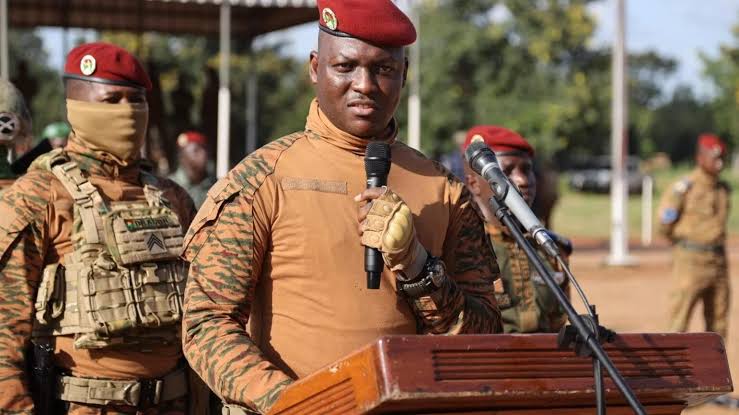
In a recent state television interview, Burkina Faso’s military ruler, Capt. Ibrahim Traoré, stated that democracy has proven detrimental to the nation and suggested that citizens should move past the notion of democratic governance.
Traoré, who took power in a coup three years ago, claimed that many Africans do not desire democracy, asserting that Burkina Faso is pursuing its own unique path, although he did not elaborate on this alternative.
Initially, Traoré vowed to restore democratic governance by July 2024. However, two months before this deadline, the junta announced an extension of its rule for an additional five years.
In January, authorities implemented a ban on all political parties as part of a strategy to “rebuild the state.”
During the interview, Traoré remarked, “People need to forget about the issue of democracy. Democracy is not for us.” He cited Libya as a cautionary example, framing himself as a revolutionary leader opposing Western imperialism.
He referenced Libya’s four-decade autocratic rule under Colonel Muammar Gaddafi, who, despite his oppressive regime, provided subsidized housing, free education, and healthcare. Gaddafi’s death during a rebellion, supported by Western intervention, has led to ongoing instability and division in Libya.
Traoré criticized Western efforts to establish democracy worldwide, claiming they frequently result in violence. Despite a trend of military coups in recent years, many African nations continue to conduct elections, albeit with allegations of manipulation favoring incumbents. Notably, military leaders in Gabon and Guinea have organized and won elections.
Addressing the ban on political parties, Traoré described them as divisive and incompatible with his revolutionary vision. He stated, “In Burkina, a true politician embodies every vice: a liar, a sycophant, a smooth-talker.”
While he did not specify an alternative system, Traoré expressed a commitment to a new approach that emphasizes sovereignty, patriotism, and grassroots mobilization, involving traditional leaders.
In the interview, he highlighted the necessity of economic and military self-reliance, advocating for longer work hours to help Burkina Faso advance economically.
Under his leadership, dissent has faced suppression, with crackdowns on opposition, media, and civil society. Critics have reportedly faced punishment by being sent to the front lines against Islamist militants.
Despite these actions, Traoré has garnered significant support across Africa for his pan-Africanist perspective and critique of Western influence.
Burkina Faso, alongside its junta-led neighbors Mali and Niger, has shifted away from collaboration with Western nations, particularly France, in combating a decade-long Islamist insurgency. Instead, they have sought military support from Russia, although violence in the region remains persistent.
A recent Human Rights Watch report indicated that over 1,800 civilians have lost their lives in Burkina Faso since Traoré’s rise to power in 2023, attributing two-thirds of these fatalities to the military and allied militias, while the remainder are linked to Islamist militants.


