

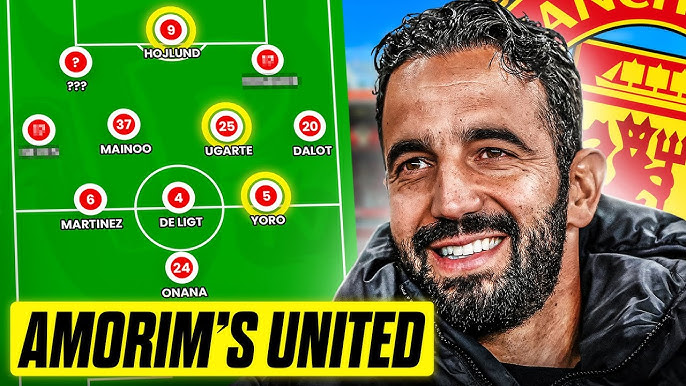
At Manchester United, the noise around formations and results often drowns out the deeper story.
For Ruben Amorim, the man at the center of Old Trafford’s latest storm, it is not simply about whether his 3-4-2-1 works on the pitch.
It is about what happens to leadership when it bends too easily to public opinion.
This week, amid another round of turbulence following the derby defeat to Manchester City, Amorim again made it clear: no shareholder, no journalist, and not even the Pope will convince him to abandon his system. The line may have been delivered with humor, but the conviction behind it is deadly serious. In Amorim’s view, giving in to outside pressure would cost him the trust of his players—the one currency a manager cannot afford to lose.
His reasoning exposes a familiar paradox in modern football: fans and pundits demand results today, yet managers insist that long-term evolution requires patience. Amorim’s refusal to alter course is not arrogance, but a statement of intent. To change under duress, he argues, would signal weakness. And in a dressing room already shaken by inconsistency, perceived weakness could unravel everything.
The backdrop makes the stance all the more striking. Sir Jim Ratcliffe, the minority shareholder tasked with reshaping the club, was spotted at Carrington this week. Officially, the visit was “pre-planned,” but the symbolism of a helicopter descent onto United’s training pitch during a fragile spell will not be lost on supporters. Still, Amorim brushed off speculation with jokes about new contracts, as though to signal that he is still in control of his own story.
Yet control at Old Trafford has always been contested. Director of football Jason Wilcox admitted publicly that the club’s structure was in worse shape than he imagined when he joined. “When will we win again?” he asked rhetorically—an acknowledgment that the issues United face are systemic, not just tactical.
And so Amorim’s battle is twofold: convincing his squad that his philosophy will eventually bear fruit, while persuading the wider United ecosystem—fans, media, shareholders—that a stubborn coach is not necessarily a failing one.
The immediate tests are unforgiving. Chelsea, Brentford, and newly-promoted Sunderland stand between Amorim and a desperately needed shift in narrative. Results in those fixtures will matter far more than soundbites about the Pope.
What is clear is that Amorim’s fight is bigger than one system or one player’s positioning. His decision to drop Bruno Fernandes deeper, even at the cost of goals, reflects a manager searching for balance in a squad still learning how to function together. To Amorim, leadership means showing that he can hold his ground, even when the ground beneath him feels like it is cracking.
In Manchester, tactical stubbornness is often read as folly. Amorim wants it to be read as strength. Whether he gets the time to prove his point is a question the next three matches may well decide.


