

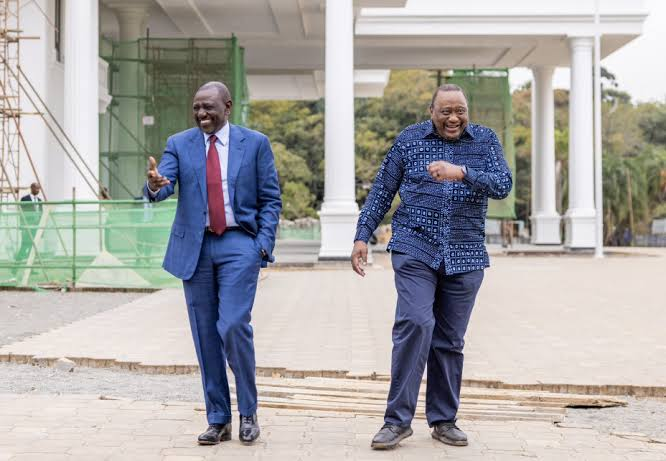
President William Ruto has shared that he visited former President Uhuru Kenyatta’s home in Ichaweri to seek his support for a new national vision, although Uhuru expressed reluctance to take on this role.
Ruto explained that he reached out to his predecessor after discussing with former Prime Minister Raila Odinga the importance of senior leaders collaborating to establish a long-term vision for Kenya.
During an interview with journalists at State House on Friday, August 21, 2026, Ruto emphasized the urgency of this initiative.
“I approached him, highlighting our current status as elders and leaders of this nation. I proposed that we collaborate to cultivate a broader vision for Kenya, which we could pass on to future generations of leaders,” Ruto stated.
He noted that Raila endorsed the idea and agreed on the necessity of involving former President Uhuru Kenyatta.
“I concurred with the former Prime Minister on the importance of reaching out to the former President,” Ruto added.
Ruto took the initiative to find Uhuru, beginning with a visit to Ichaweri.
“I made a concerted effort to connect with him, starting with my visit to Ichaweri,” Ruto recounted.
He later met Uhuru at his office in Nairobi to continue advocating for the same vision.
Ruto expressed his desire for Uhuru, as a former head of state, to contribute his experience to help unite senior leaders around a new national vision.
“I also visited him in his office and urged him to assist us as the only living former head of state in forging a new vision for our country,” he remarked.
Despite his efforts, Ruto shared that Uhuru did not accept the proposal.
“However, he was hesitant and expressed uncertainty about wanting to engage,” Ruto explained.
This account follows Ruto’s recent announcement of a plan to develop a new long-term national development strategy that will succeed Vision 2030.
On July 30, the President launched the Vision 2060 initiative, underscoring the need for a new development blueprint to guide Kenya toward achieving high-income and industrialized status. Nationwide consultations on the proposed vision commenced on August 12.
Ruto positioned Vision 2060 as a collaborative national project that transcends electoral cycles and individual administrations. The initiative aims to build upon Vision 2030 while addressing any unmet targets.
Ruto clarified that his outreach to Uhuru was not intended as a request for a political alliance, but rather an appeal for his contribution to a national initiative.
Nonetheless, Ruto expressed disappointment over Uhuru’s refusal.
“Ultimately, those are the choices individuals make,” Ruto remarked.
Ruto then suggested that Uhuru’s decision not to participate in the initiative reflects his ongoing involvement in opposition politics.
“My predecessor had the opportunity to assume the role of a statesman, rising above politics to become a unifying figure in our country,” Ruto stated.
“Instead, he opted to step down and engage as an opposition leader.”
Ruto pointed to Uhuru’s role as chairman of the Azimio la Umoja One Kenya Coalition as evidence of his continued political engagement.
“He remains the chairperson of Azimio, actively organizing opposition efforts against me,” Ruto noted.
These comments arise amid increasing political activity leading up to the 2027 General Election, with opposition leaders striving to form a coalition to challenge Ruto.
Kalonzo Musyoka previously urged Ruto to refrain from criticizing Uhuru, allowing the former President to enjoy his retirement. The Wiper leader emphasized that Uhuru deserves respect as a former head of state and questioned the rationale behind pressuring him to participate in Vision 2060 if he is unwilling.
“If he has declined the role of chairman for Vision 2060, why impose it on him?” Kalonzo asked.
He also encouraged Ruto to respect Uhuru’s position within Azimio and cease the criticisms.


