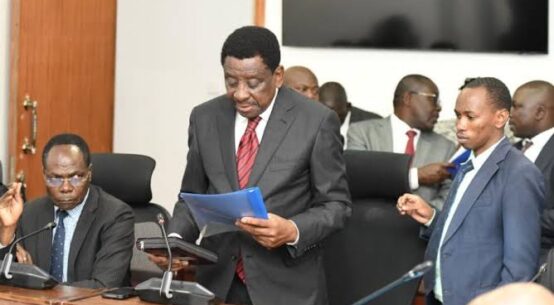


In a landmark ruling, a three-judge bench of the High Court has declared that the Kenya Kwanza coalition, led by President William Ruto, does not hold the majority status in the National Assembly. The ruling comes in response to allegations of constitutional violations committed by Speaker Moses Wetang’ula when he made a controversial determination regarding party memberships.
The court’s decision stems from an October 6, 2022, ruling by Speaker Wetang’ula, who reassigned 14 members from various parties to Kenya Kwanza, enabling the coalition to claim a majority presence. However, the judges found that the Speaker lacked a valid basis for these reassignments and subsequently quashed his declaration of Kenya Kwanza as the majority party.
According to the Speaker’s earlier assessment, Kenya Kwanza boasted 179 members compared to 157 from the Azimio la Umoja One Kenya coalition. However, official records from the Registrar of Political Parties indicated that, as of April 21, 2022, Azimio comprised 26 political parties, while Kenya Kwanza consisted of only 15.
“The Speaker cannot disregard the Registrar of Political Parties,” the court stated. “Without the necessary coalition agreements presented during the debate, he had no foundation for his decision.”
In their unanimous judgment, Justices John Chigiti, Lawrence Mugambi, and Jairus Ngaah criticized the Speaker for his lack of impartiality and failure to adhere to constitutional principles. They emphasized the pivotal role of the Speaker in maintaining public trust in parliamentary processes.
“By reallocating 14 members to Kenya Kwanza without justification and declaring it the majority party, the Speaker violated the Constitution,” the judges concluded.
The bench further pointed out that Wetang’ula’s dual role as both Speaker and leader of Ford Kenya was unconstitutional. “This dual role is unlawful,” they stated. “Upon becoming Speaker, he ceased to be the leader of Ford Kenya.”
This ruling carries significant ramifications for the leadership dynamics within Parliament, raising questions about the legitimacy of actions taken under the pretense of Kenya Kwanza’s majority status. It also highlights the judiciary’s critical role in upholding the rule of law in Kenya.
As the dust settles from this ruling, the potential for a realignment within Parliament remains uncertain. The implications of the court’s decision are expected to resonate throughout Kenya’s political landscape in the coming weeks.