

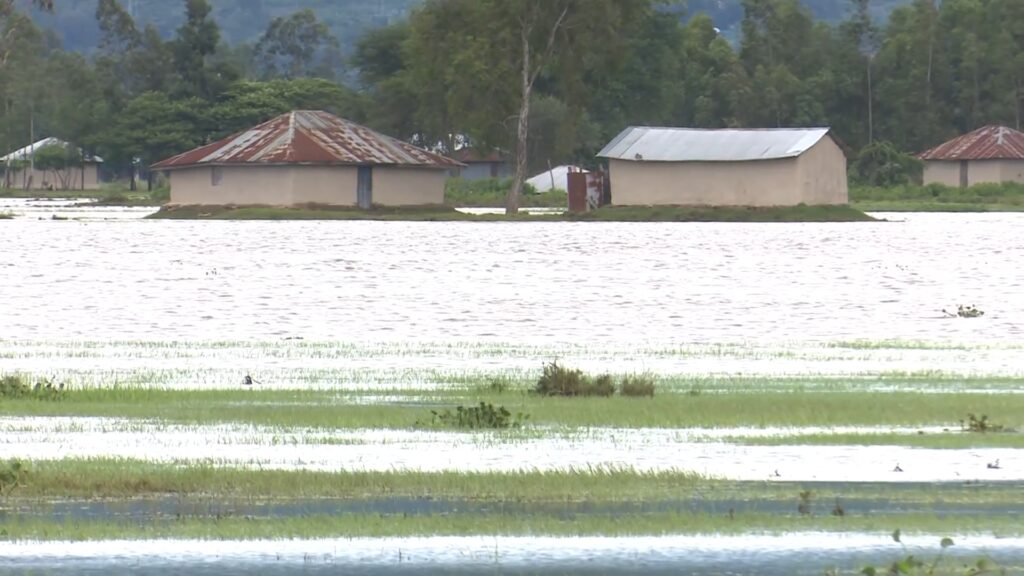
Recent floods in Kisumu and Homa Bay counties have displaced hundreds of families and impacted thousands more after River Miriu overflowed its banks due to prolonged heavy rains.
The deluge has wreaked havoc, demolishing homes, submerging agricultural land, and isolating key roadways, leaving residents in precarious situations. The Kenya Meteorological Department has issued warnings of additional rainfall expected in the upcoming week.
In Nyakach, Kisumu County, over 700 residents have been compelled to evacuate their homes as River Miriu flooded villages and devastated crops.
A once-bustling village road in Sango Rota, West Nyakach, now lies submerged under muddy floodwaters.
This vital route, used daily by residents to access markets, schools, and healthcare facilities, has vanished beneath the swollen river.
In its absence, a small wooden boat serves as the sole means of transportation for those stranded, enabling them to cross the flooded area.
Displaced families have relocated to higher ground, where temporary camps have been established as the floods continue to spread.
Local resident Florence Achieng expressed deep concern as the floods have obliterated their crops, leaving families without any means of livelihood.
She lamented the loss of all their agricultural produce, emphasizing their urgent need for assistance.
Another resident, Silas Kisia, noted that homes and roads have succumbed to the rising waters, forcing villagers to depend entirely on boats for transportation.
“Everything is submerged. Homes have been destroyed, and people have been compelled to relocate. Where roads once existed, we now rely on boats. It is an unfortunate situation,” he stated.
Residents describe the floods as a recurring calamity in their community.
James Were voiced his frustration, stating that local leaders have yet to offer any assistance amid their suffering.
“We have not seen our area leaders come to help us despite the challenges we are facing,” he remarked.
Lower Kadianga assistant chief Regan Ouma confirmed that local authorities have set up three evacuation centers to accommodate the displaced families.
“We have established three evacuation centers. At Nyadina PAG, approximately 250 displaced individuals are sheltering, while Obange hosts 200 and Nyakoda accommodates another 250,” he reported.
Residents highlighted that flooding along River Miriu has plagued the area since 1962, repeatedly destroying homes and crops.
They emphasized the urgent need for a permanent solution to these floods.
Some community members recalled that although Budalang’i once faced severe flooding, the situation improved following the implementation of flood control measures, and they are now advocating for similar initiatives in their region.
In neighboring Homa Bay County, at least 500 families have also been displaced due to the overflowing River Miriu.
Among them, 381 families in Kobala sublocation, Wang’chieng ward, within Karachuonyo constituency, have been affected.
These families hail from Konyango village, Kawuor Agindo, Kasirawa, and Komenya villages.
Local authorities reported that approximately 56 hectares (138 acres) of farmland have been devastated, with numerous homes remaining stranded by floodwaters. Household items, livestock, and crops have also been lost to the flooding.
A multi-agency team led by the Kenya Red Cross Society has been evacuating affected families using boats.
Many are currently seeking refuge at Osodo Comprehensive School and nearby churches.
The displaced families are urgently appealing to the government for food and essential supplies to sustain them in the camps.
Kobala assistant chief George Oburu stated that the floods could have been mitigated if flood control projects along River Miriu had been completed.
He urged for the prompt completion of stalled dykes along the river to address the persistent flooding issues in the area.
Homa Bay Governor Gladys Wanga assured that the county government has delivered relief supplies and is assessing the situation on the ground.
She emphasized that beyond immediate relief efforts, the county government is dedicated to implementing long-term strategies, including the construction of dykes to manage flooding and safeguard communities from future disasters.
Residents in both counties assert that while emergency relief is crucial, their most pressing need remains a sustainable solution to the floods that continue to devastate homes, farms, and livelihoods along River Miriu.