

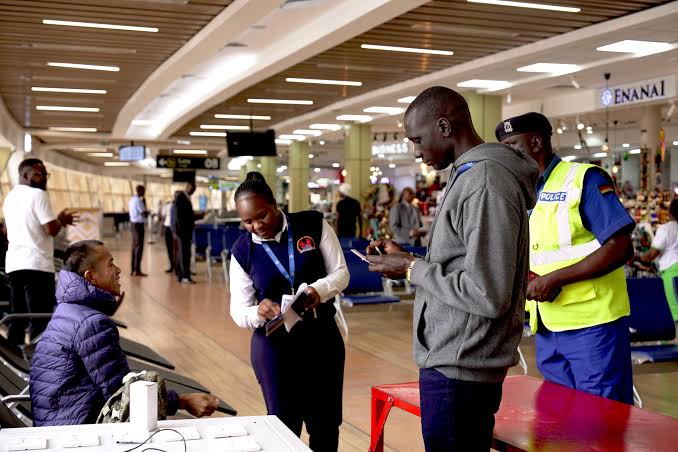
Police officers from the Kenya Police Service have apprehended two individuals linked to human trafficking attempts at Jomo Kenyatta International Airport.
In a statement released by the Kenya Police Service on X on Saturday, February 7, 2026, the police confirmed that the suspects were detained during separate incidents while attempting to travel to the United Kingdom and Amsterdam.
“Vigilant officers at Jomo Kenyatta International Airport (JKIA) have successfully thwarted two significant immigration fraud and human trafficking attempts,” the police stated.
In the first incident, authorities reported that one suspect was found in possession of a forged Bosnia and Herzegovina visa.
“Iman Dib was arrested while en route to Amsterdam after officers discovered the forged visa. His accomplice, Samira Dib, was also taken into custody and will face charges related to human trafficking,” the police added.
In a second operation, officers apprehended a Sudanese national who held a forged UK residence permit.
“Ahmed Eltayeb, a Sudanese national traveling to the UK, was arrested alongside his Kenyan facilitator, Abdullahi Ali, after officers found him in possession of a forged UK residence permit,” the police noted.
Addressing Human Trafficking
Human trafficking remains one of the most critical human rights challenges globally, impacting millions of vulnerable individuals across borders.
Each year, the United States Department of State publishes its Trafficking in Persons (TIP) Report, which ranks governments based on their efforts to combat forced labor, sex trafficking, and modern slavery.
In the 2025 edition of the report, Brazil and South Africa were downgraded to the Tier 2 Watch List, raising alarms about declining efforts. Conversely, Kenya maintained its Tier 2 status, reflecting both progress and the urgent need to address ongoing gaps.
Understanding Tier 2 Status
Tier 2 countries do not fully meet the minimum standards for the elimination of trafficking but demonstrate significant efforts towards compliance. For Kenya, this designation acknowledges progress while underscoring systemic weaknesses that leave thousands of victims vulnerable. The report commended Kenya for:
– Increasing investigations, prosecutions, and convictions of traffickers.
– Identifying and referring more potential victims for assistance.
– Opening its first state-run shelter for trafficking survivors.
– Engaging Kenyan returnees from the Gulf to inform anti-trafficking policies.
However, the report also highlighted critical shortcomings. Despite notable advancements, several persistent issues remain:
– Weak Victim Protection: Services are limited, particularly for adults and victims outside major urban areas, leaving many survivors at risk of retraumatization due to inadequate support systems.
– Migrant Worker Vulnerabilities: Fraudulent labor recruitment agencies continue to operate, exposing Kenyans—especially domestic workers in Gulf countries—to abuse, withheld wages, and confiscated passports.
– Complicit Officials: Allegations persist regarding some government officers colluding with traffickers by issuing fraudulent documents or extorting victims seeking assistance.
– Legal Loopholes: Current laws permit fines instead of mandatory jail terms for sex trafficking offenses, undermining deterrent effects. Efforts to reform these loopholes have stagnated for years.


