

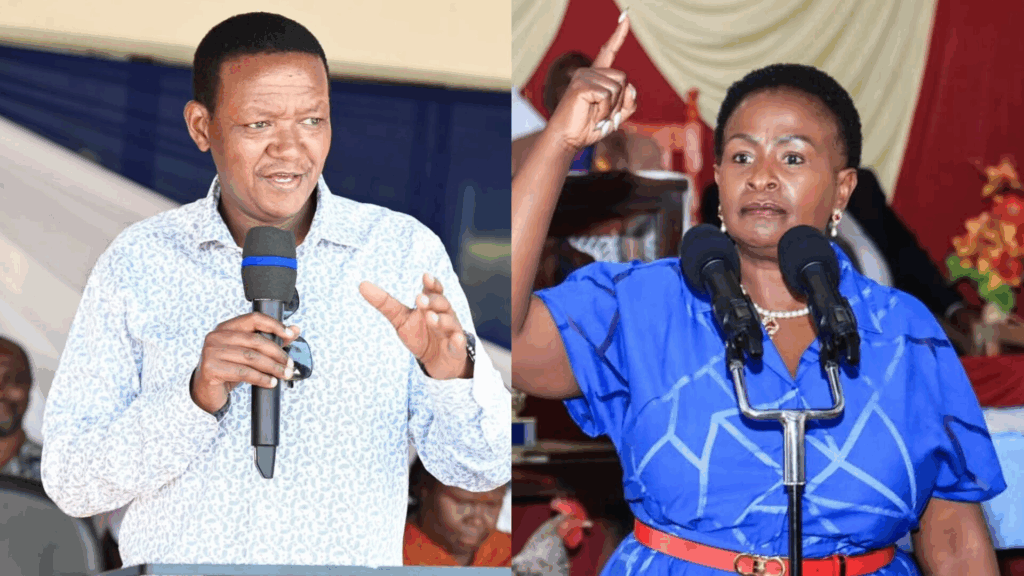
Machakos Governor Wavinya Ndeti recently criticized former governor Alfred Mutua for seemingly reviving his “Cobra Squad” filming persona, all while defending her administration’s development achievements in the county. Ndeti highlighted that Mutua, now serving as a Cabinet Secretary, appears to be reigniting a dormant filming career amidst uncertainties regarding his political standing within the United Democratic Alliance (UDA).
“It is amusing to witness former Machakos Governor Alfred Mutua, now Labour Cabinet Secretary, attempting to bring back his long-abandoned ‘Cobra Squad’ filming career,” Ndeti stated on Tuesday, August 18, 2026.
Her comments followed Mutua’s “mini-tour” of Machakos Town, where he visited Machakos Level 5 Hospital and Machakos People’s Park. During this tour, he raised concerns about the state of facilities he claimed were developed during his time as governor. This exchange has turned the former governor’s stroll through Machakos into a new political debate about the county’s development, with Mutua emphasizing maintenance and Ndeti showcasing new investments and service delivery.
In response, Mutua began his tour at Machakos Level 5 Hospital, engaging with doctors, nurses, and healthcare workers to hear their experiences. “A hospital is more than just buildings and equipment,” he remarked, stressing that healthcare quality should also reflect the welfare of healthcare workers and the dignity of patients.
While acknowledging the dedication of hospital staff, Mutua emphasized the need for “continuous investment, proper management, and maintenance” in healthcare facilities to adequately serve the community.
His strongest criticism emerged at Machakos People’s Park, a flagship project from his governorship. He noted that the park, once a prominent public space and “the pride of Machakos,” has sadly declined. “Today, it is a mere shadow of its former self,” he lamented, highlighting that its current state has led to jokes about it being a “snake park.” He argued that the condition of this facility raises serious questions about leadership and maintenance, rather than merely nostalgia for his time in office. “Development involves not just launching and commissioning projects,” he stated. “It requires maintaining them, safeguarding public investments, and ensuring they continue to benefit the people.”
“Leadership must ultimately be evaluated based on results, not just rhetoric or promises,” he asserted, emphasizing that the residents of Machakos “deserve better.”
In her defense, Ndeti shifted the focus from Mutua’s critique of existing facilities to her administration’s investments across the county. She pointed out that Machakos has received billions of shillings over the past decade, although the full benefits of devolution have not always reached residents.
Ndeti emphasized her administration’s commitment to youth empowerment through the Machakos Youth Service, which provides practical skills and pathways to self-employment. She also highlighted initiatives such as Maziwa ya Mama and the ECDE School Feeding Programme, which have significantly improved enrollment, nutrition, and attendance among early childhood learners.
Regarding infrastructure, Ndeti noted that six major roads are currently undergoing tarmacking, alongside ongoing road grading, opening, and rehabilitation throughout the county.
Healthcare remains a focal point in her defense, as Ndeti detailed investments in medical equipment, facility upgrades, staffing enhancements, and improved diagnostic services, asserting that healthcare is now more accessible to residents.
She further pointed to significant investments in agriculture and water, including over 100 surface-water harvesting projects that support irrigation, livestock, and household needs.
Ndeti contended that the county’s development narrative should not be reduced to political appearances or projects from previous administrations. “The story of Machakos today is not about cameras, staged productions, or political theatrics,” she declared. “It is about results, transformation, and directing resources to directly enhance the lives of our people.”
Meanwhile, Mutua expressed that his tour reinforced his belief that development must be both visible and sustainable beyond the tenures of the leaders who initiate projects. “Development must be seen, felt, and sustained,” he asserted.
This clash highlights two contrasting perspectives on Machakos’ development record: Mutua advocating for proper maintenance and accountability of public projects, while Ndeti points to new programs and infrastructure as evidence of progress under her leadership.
Ultimately, for residents, this political dispute centers around a critical question both leaders addressed in different ways: Are public investments translating into tangible services and facilities that are accessible, utilized, and sustainable?


