
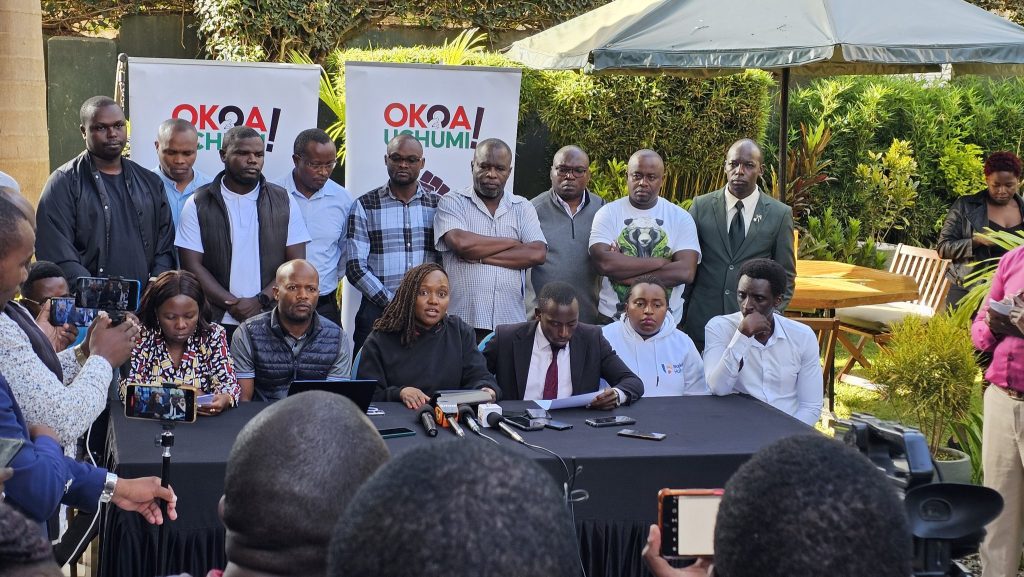
Kenya’s debt problem is fast becoming a national nightmare. A new report by Okoa Uchumi Kenya shows that the government is now spending seven out of every ten shillings of its revenue collection on repaying loans — a figure that paints a grim picture of the country’s finances and future debt management.
The report, released on October 7, 2025, estimates Kenya’s public debt at Ksh11.81 trillion, a figure which is split between Ksh6.3 trillion in domestic loans, and Ksh5.48 trillion in foreign borrowing.
But even that figure, the group notes, might not be the full story due to limited information disclosure from state institutions.
Domestic Borrowing: The Poor Pay While the Rich Profit
The findings suggest that local borrowing has become a quiet engine of inequality. Much of the government’s domestic debt is financed by wealthy individuals and corporations, meaning the interest payments — drawn from taxpayer money — mostly enrich those already well-off.
“Kenya is already deep in a debt crisis,” said Alexander Riithi, Head of Programs at The Institute for Social Accountability (TISA). “Domestic borrowing has overtaken foreign loans and is more prone to misuse. With external debt, there’s some traceability; with domestic debt, it’s harder to follow the money.”
Riithi warned that the burden of repayment has eroded public services and widened economic hardship. “We have hospitals where people die waiting for care, schools without basic facilities, and a job market where nearly a third of Kenyans are unemployed,” he said.
Budgets Without Oversight
Accountability groups are also raising the alarm over supplementary budgets, which they say have become a tool for reckless spending. These mini-budgets often increase government expenditure without adequate scrutiny from Parliament.
Diana Gichengo, Executive Director of TISA, urged the Treasury to halt unapproved spending and reform the National Government Constituency Development Fund (NG-CDF), arguing that it has strayed from its original purpose. There has been hue and cry on the mismanagement of NG-CDF, with many claiming that politicians are using the multi million funds to benefit those constituents who align with their political idealogies.
“Every supplementary budget widens the fiscal gap,” she said. “We can’t talk about financial discipline while authorizing expenses we never debated. NG-CDF also needs to be cleaned up — it has to serve people, not politics.”
Questioning the Role of Global Lenders
The report has revived debate on Kenya’s long relationship with the International Monetary Fund (IMF) and the World Bank, which continue to lend heavily to Nairobi despite growing public concern.
Saboti MP Caleb Amisi said it’s time to rethink those partnerships, arguing that their conditions often hurt rather than help developing economies.
“These institutions were designed to rebuild Europe after World War II,” Amisi said. “Africa needs a new financial model — one that reflects our realities, not someone else’s history.”
Beyond Numbers: The Human Cost of Debt
Experts warn that Kenya’s debt story is not just about fiscal policy — it’s about how people live.
Jason Rosario Braganza, Executive Director of the African Forum and Network on Debt and Development (AFRODAD), said the country must begin to view debt through the lens of governance and social justice.
“Debt is not only about figures in a ledger,” he explained. “It determines how we govern, how we share resources, and who benefits from growth. The choices we make today will shape the kind of society we leave behind.”
Okoa Uchumi Kenya warns that unless urgent reforms are made — including full transparency in borrowing, tighter spending controls, and stronger oversight — the country could soon fall into a permanent debt trap.
As the government struggles to meet repayment deadlines, public services continue to shrink and taxpayers carry the weight of decisions made behind closed doors.
The question many Kenyans are now asking is simple: how much longer can the country borrow its way out of trouble?