

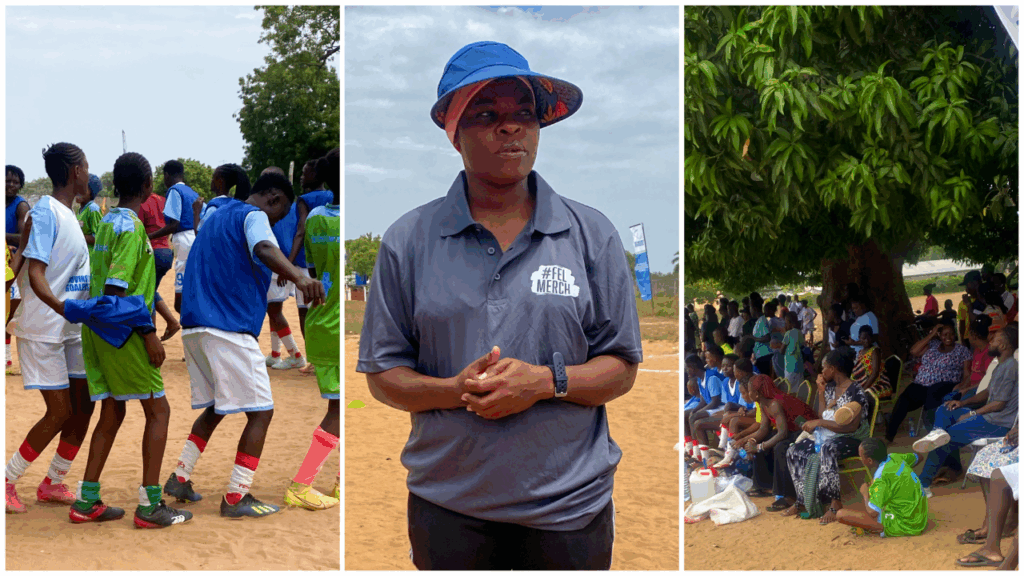
By 9 a.m., Fathime Omari stands confidently on a football pitch in the charming creekside community of Mnarani, located in Kilifi County.
Having already seen her child off to school, she now fully embraces her role as a coach, whistle in hand, guiding the technical drills for Moving The Goalposts (MTG) United. Known affectionately as ‘Coach Tibu’ within her community, the 32-year-old serves as the head coach of MTG’s football team. Her presence on the sidelines intentionally challenges the status quo in a region where professional sports coaching is predominantly male.
“Honestly, being a female football coach presents its challenges,” Omari shared with Bird. “In this league, around 90 percent of the coaches are men. Competing against them often creates pressure, as they feel they are up against a woman, and some believe a woman cannot defeat them.”
As a holder of a CAF B Licence—the only woman in the coastal region to achieve this professional milestone—Tibu signifies a transformative shift in the local football landscape. She emphasizes that her role extends beyond tactical instruction; it involves cultivating the internal confidence of her players, empowering them to perform effectively on the field.
Her Journey Begins
In 2006, a 12-year-old Omari joined Moving the Goalposts out of curiosity more than skill. MTG is a sport-for-development organization that leverages the football pitch as a platform for leadership and economic independence, steering away from mere recreational activities towards a professional “Play to Purpose” model.
Reflecting on her early experiences with a smile, she recalls struggling to kick a ball even five meters. Her participation sparked debate in her community, where many questioned the appropriateness of a Muslim hijabi-wearing girl engaging in sports and wearing athletic shorts.
However, respect replaced criticism when Omari faced a pivotal moment after primary school. With no financial support for further education, her future appeared bleak until her talent on the pitch secured her a full high school scholarship. “See the benefits of playing football?” she would remind her skeptics. By funding her own education through sports, she demonstrated that football transcends mere play; it serves as a lifeline.
Her swift transition from player to coach began at just 15, when she took charge of the under-13 team. By 23, she ascended to the position of head coach for MTG United.
In 2018, she led her team to an impressive second-place finish in the Kenyan Women’s League, accumulating 34 points and falling just two points shy of the champions.
Shattering Barriers
Globally, women occupy only about 3 percent of high-performance coaching roles in predominantly male leagues, such as the NBA. In Africa, the Confederation of African Football (CAF) has recently made strides by licensing 267 new female coaches (Levels D through B) in 2025 alone.
MTG’s executive director, Dorcas Amakobe, asserts that the achievements of leaders like Coach Tibu exemplify how sports can serve as a catalyst for changing societal expectations.
“Fatime embodies how women are reshaping narratives within their communities,” she states. “She has played a crucial role in making female leadership visible, inspiring girls to learn from everyday role models. She illustrates that women and girls can lead and coach in spaces previously deemed inaccessible.”
Beyond tactical drills, Omari perceives the pitch as a classroom for life skills. During home games, she actively participates in preparing the field, marking lines and setting up nets alongside her players, fostering trust and discipline.
“This platform provides a free space for them to share ideas and build confidence,” Omari emphasizes. This mentorship has significantly impacted players like team captain Rita Jilani. Once shy, the 22-year-old attributes her newfound courage to Coach Tibu’s guidance.
“Fathime has equipped me with skills to tackle challenges I previously couldn’t face,” Rita expressed. “She has taught me the importance of perseverance.” This grassroots movement is part of a broader success narrative unfolding across Africa. In 2024, Zambian striker Racheal Kundananji made headlines with a record-breaking $860,000 (Sh110 million) transfer to Bay FC in the United States.
Similarly, South Africa’s Dr. Desiree Ellis, a four-time CAF Women’s Coach of the Year, has proven that African women can excel on the global coaching stage.
Overcoming Gender Bias
Despite her accomplishments, Omari candidly acknowledges the competitive and sometimes hostile nature of the professional landscape. She recounts the ridicule she endures from opposing fans and male coaches struggling to accept a woman in a leadership role.
“Fans may hurl insults, but as a woman, resilience is essential,” she stated.
Omari also sheds light on the systemic ‘motherhood penalty’ that compels many talented women to choose between family and career.
“Motherhood adds another layer of complexity. Many women exit the field due to a lack of support in balancing family responsibilities with the demanding nature of professional sports,” she explained.
Yet, she adeptly manages her domestic duties alongside her professional aspirations, demonstrating that motherhood need not hinder a career in sports.
Throughout the region, the sidelines of women’s football are experiencing a profound social transformation, as an increasing number of men transition from skepticism to support. Male spectators now recognize that female athletes exhibit both technical skill and physical intensity.
Wycklife Omondi, a Pwani University student and regular attendee at the games, notes that the appeal lies in the exceptional quality of competition. “I enjoy watching these games because it’s exhilarating to see girls on the field playing as aggressively as men,” he remarked. The 2025 Class of the 50 Most Influential African Women in Sports included leaders such as NBA Africa CEO Clare Akamanzi and Rwanda Sports Minister Nelly Mukazayire, marking a shift where women are not only participating in the game but also driving the business.
Creating Social Change
Under Omari’s guidance, top player Nelly Kache emerged as a leading scorer, eventually securing a professional contract with a team in the Tanzanian Premier League, further advancing women’s football in East Africa.
Ferdinand Mwambire, head coach of the Kilifi County U23 team, asserts that true transformation in women’s sports requires establishing strong technical leadership at grassroots levels.
“It’s vital to position accomplished women achievers at foundational levels to inspire young women,” Mwambire, who also coaches the regional Chapa Dimba winners, emphasized.
As the final whistle signals the end of the day’s training, the influence of leaders like Omari is evident, measured not merely in technical drills but in the evolving mindset of an entire community. By professionalizing the game and claiming technical roles once reserved for men, they are ensuring that the football pitch continues to serve as a powerful laboratory for leadership.


