

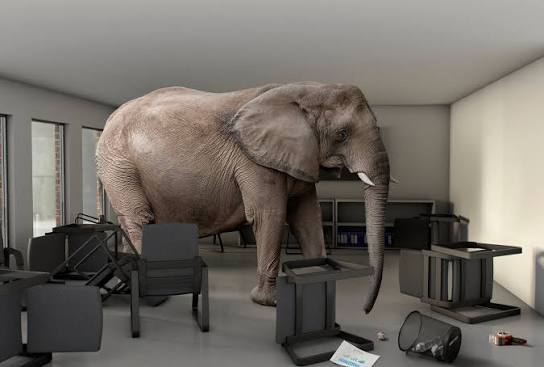
When a significant issue remains unacknowledged or avoided, particularly when addressing it could resolve numerous smaller concerns, we encounter the proverbial “elephant in the room.” But what does this phrase truly signify?
This intriguing expression has historical roots in serious discussions surrounding philosophy and logical reasoning from the early 20th century. Originally, it didn’t carry the same connotation as it does today.
The Philosophical Elephant
The Oxford English Dictionary traces the earliest use of “elephant in the room” back to 1935, when American philosopher and psychologist Professor Harry Todd Costello, an assistant to Bertrand Russell, published an essay titled “A Philosopher Among the Metaphysicians.” In this work, Costello highlighted how scientific and metaphysical perspectives differ in understanding the observable versus the unobservable. He remarked:
“If I say that there is something in my room that resembles a chair, that is science; but if I claim it remains there when I look away, that is mere speculation. It’s essential to recognize that asserting there isn’t an elephant in the room goes beyond observation, as I cannot perceive what is absent.”
Costello’s phrasing, particularly “Let us remember…,” indicates that using the metaphor of an invisible elephant to illustrate an unknowable truth was likely already familiar among philosophical circles of that time. Upon further exploration, we find that this unique expression has even older origins.
The Older Fables and Jokes
Historically, elephants have served as punchlines in jokes since the early 1900s, capitalizing on their immense size. Mark Twain’s 1882 short story, “The Stolen White Elephant,” contributed to the idea of an elephant as a metaphor for something so large that it cannot be overlooked.
Even earlier, a fable called “The Inquisitive Man,” penned by Russian author Ivan Krylov in 1814, illustrates this concept. In the tale, a man marvels at various small wonders in a museum but fails to see a massive elephant on display, highlighting the absurdity of ignoring something so conspicuous.
Long before Costello popularized the concept in philosophical discussions, stories like Krylov’s had firmly established the elephant as a metaphor for something overwhelmingly evident that one simply cannot overlook.
The Modern Shift
Throughout the late 20th century, the phrase “elephant in the room” primarily circulated within philosophical discourse, defined by the Oxford English Dictionary as “something obvious and incongruous… which may or may not correspond to observable facts.” However, by the 1980s, the term gained broader usage, becoming a part of everyday language.
This shift occurred when the phrase was notably featured in the title of the best-selling 1984 book, “An Elephant in the Living Room,” which addressed the realities faced by children of alcoholic parents. This publication played a crucial role in cementing the expression in modern vernacular as a reference to glaring issues that people choose to ignore.