

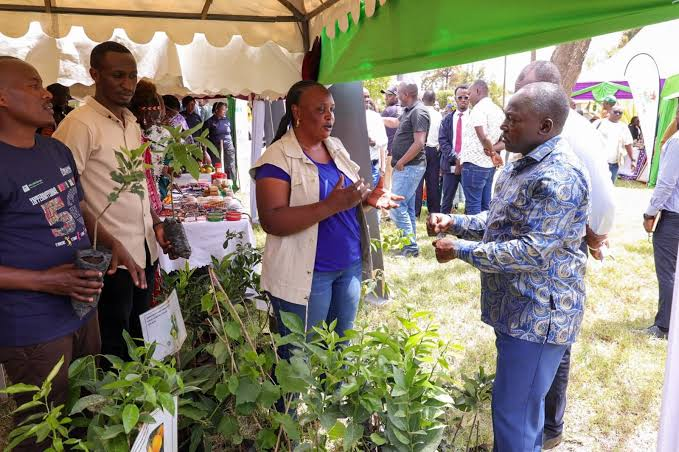
Laikipia County has joined a growing movement among Kenyan counties by adopting agroecology policies, following the lead of Murang’a, Vihiga, Kiambu, West Pokot, Nakuru, and Makueni in promoting sustainable food production.
This innovative policy aims to guide farmers toward production methods that minimize reliance on synthetic fertilizers, pesticides, and other agricultural chemicals, while safeguarding soils, water resources, and the broader environment.
During the launch at his Nanyuki office on September 4, 2026, Governor Joshua Irungu emphasized that Laikipia’s adoption of this policy signifies a pivotal change in food production practices within the county.
“Today, Laikipia County has achieved a significant milestone by introducing our agroecology policy,” Irungu declared.
By aligning with Murang’a, Vihiga, and Kiambu, Laikipia positions itself among counties that have been developing tailored frameworks to promote agroecological farming.
Murang’a pioneered this movement by launching its Agroecology Development Policy in 2022, later operationalizing it through legislation. Following suit, Vihiga, Kiambu, and West Pokot created their frameworks, while Nakuru embraced its policy in December 2025. Makueni also introduced its Agroecology Policy in November 2025, furthering the initiative for sustainable agriculture across the region.
Laikipia has actively worked on finalizing its policy and Bill, engaging stakeholders in consultations prior to the launch.
Governor Irungu expressed optimism that this policy could enhance access for Laikipia farmers to international markets, where buyers enforce stringent standards for food production.
“Laikipia County will produce food that meets the quality required for sale in European markets,” he stated.
He noted that horticultural farmers, in particular, could reap significant benefits by adopting practices that align with international standards.
The governor highlighted that the policy would address the use of chemicals in crop production as well as medications administered to livestock.
“Agroecology, in essence, involves implementing farming practices with a focus on environmental stewardship,” Irungu explained.
He also connected this initiative to concerns surrounding food safety and the increasing prevalence of non-communicable diseases, urging farmers to prioritize the quality of inputs in food production.
Irungu pointed out the financial strain that diseases like cancer and kidney failure impose on families and the nation.
“Through this initiative, Laikipia aims to contribute to extending and transforming the lives of our people.”
The true challenge lies in ensuring that this new policy translates into tangible support for farmers, including access to extension services, affordable alternatives to chemical inputs, and markets willing to pay a premium for sustainably produced food.