

Russian forces executed a significant drone and missile attack on Kyiv overnight, resulting in the tragic loss of 25 lives. The city’s mayor, Vitaly Klitschko, characterized this assault as the most extensive strike on the Ukrainian capital to date.
According to Ukraine’s State Emergencies Service, 85 individuals sustained injuries, including two children. Klitschko reported that an ambulance station was among the affected sites.
While previous attacks have resulted in higher casualty figures, this recent assault unleashed the largest array of weaponry on the capital, impacting a broad range of locations.
In response to warnings from Ukrainian President Volodymyr Zelensky about impending attacks, several neighborhoods underwent evacuation as strikes commenced.
Moscow justified its actions by claiming to target military facilities as retaliation for attacks on Russian civilian infrastructure. Kremlin spokesman Dmitry Peskov stated that Russia aims to intensify pressure on the Kyiv regime to meet its objectives.
Ukraine accused Moscow of deliberately targeting civilian areas, emphasizing the moral distinction between an aggressor and a nation defending itself.
Tymur Tkachenko, head of Kyiv’s military administration, reported that children were among the significant casualties, noting, “The enemy is once again intentionally striking residential areas and harming civilians.”
Kyiv’s metro authorities indicated that 52,500 individuals, including 4,500 children, sought refuge in underground stations overnight, marking the highest shelter usage in recent years.
The attack impacted a high-rise apartment block in the Darnitskyi district, where two missiles caused extensive damage. One missile left a massive crater near a kindergarten, while the other struck a nine-story residential building, leading to its partial collapse.
Local residents described the aftermath: smashed cars, shattered windows, and a thick layer of ash covering the area. Rescuers worked diligently to sift through the debris, with anxious relatives watching in despair.
Svitlana, a neighbor, shared her experience, stating she hid in her corridor during the air raid and heard the explosions. She reflected on her past trauma, having lost her mother in a previous strike and her son in combat two years later.
Oleksiy, injured by flying glass, expressed disbelief at Moscow’s claims of retaliation, asserting, “They initiated this war. This is a residential area, and they targeted it.”
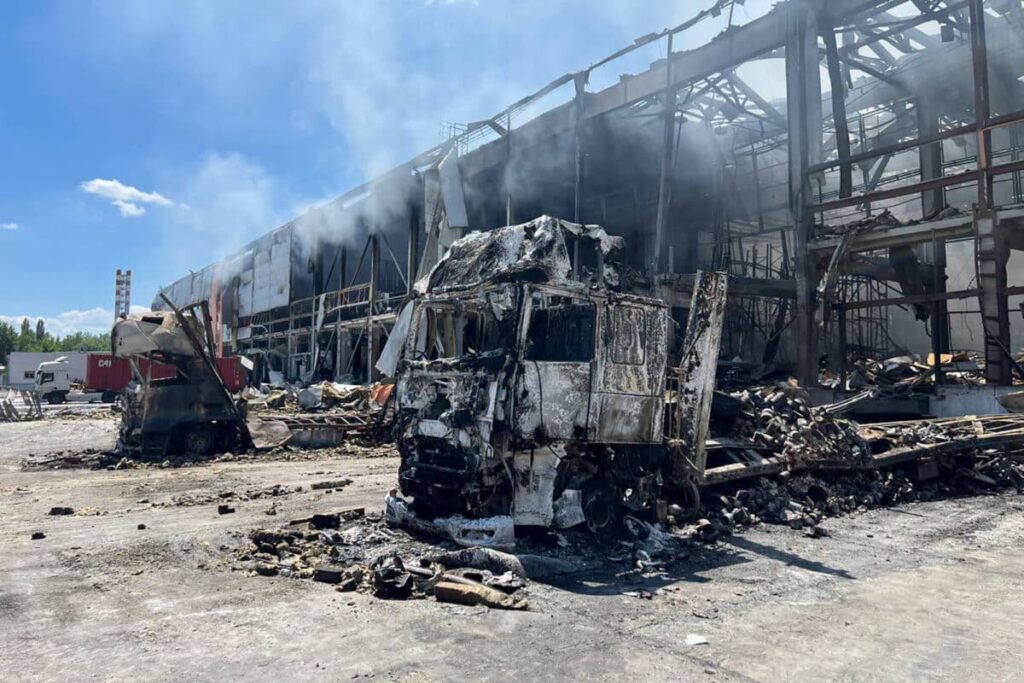
The humanitarian impact is profound. The Ukrainian Red Cross reported that its warehouse was destroyed in the strikes, resulting in a loss of supplies valued at over £1.3 million (79 million Ukrainian Hryvnia). This loss of around 320,000 relief items will hinder emergency and humanitarian operations across Ukraine.
The assault on Kyiv unfolded over 11 hours in multiple waves, commencing with a drone strike in the historic quarter and escalating to dozens of ballistic and cruise missiles. Residents noted a shift in the pattern of attacks, observing that while strikes might occur less frequently, they are longer and more intense.
Ukrainian military experts labeled this recent barrage as one of the most formidable challenges for the nation’s air defenses in recent months. Aviation expert Bohdan Dolintsev explained that Russia’s strategy of deploying various weapon types simultaneously complicates Ukraine’s defense efforts.
The Ukrainian air force confirmed that Russia launched 74 missiles and 496 drones, mainly targeting Kyiv. Although Ukraine’s air defenses repelled most, 25 ballistic missiles and 12 drones struck 33 locations.
In light of these developments, Ukraine urgently called for enhanced air defense systems from its allies. President Zelensky appealed to Washington for licenses to produce Patriot defense missiles domestically.
Russia also targeted military bases in central and eastern Ukraine, claiming to hit Ukrainian defense and energy infrastructure in retaliation for what it termed “terrorist attacks” by the Kyiv regime against civilian facilities in Russia.
Kyiv has recently conducted long-range strikes on Russian power stations from Moscow to the Black Sea, prompting a rare acknowledgment from President Vladimir Putin about fuel shortages in Russia.
Ukrainian Foreign Minister Andriy Sybiha condemned attempts to justify the Russian strikes as retaliation, asserting, “In this war, there is an aggressor and a country defending itself.”
Since launching its full-scale invasion of Ukraine in February 2022, Russia has gained control of approximately one-fifth of Ukrainian territory.


