

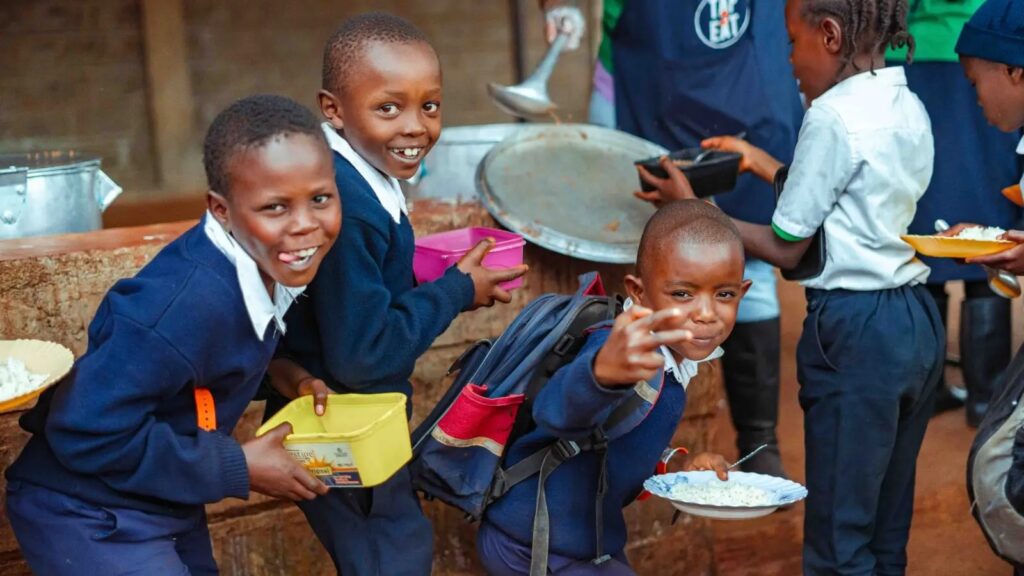
Everyday, millions of children in Africa attend school on empty stomachs, highlighting a significant economic and social failure.
Discussions surrounding Africa’s economic transformation often emphasize infrastructure, industrialization, and technology. However, one crucial driver of growth remains overlooked: school feeding programs.
This oversight arises partly from viewing school meals as charity rather than a strategic investment. In truth, school feeding intersects education, agriculture, and labor productivity. When implemented effectively, it becomes an investment in human capital and economic resilience, not merely a welfare initiative.
According to the United Nations World Food Programme’s State of School Feeding Worldwide report, 87 million children in sub-Saharan Africa received daily school meals as of last September, marking a 30% increase from 66 million in 2022.
This growth illustrates the potential when countries prioritize school feeding. In Chad, Ethiopia, Madagascar, and Rwanda, the number of children benefiting has surged by up to six times, showcasing strong political will and targeted investment.
A hungry child struggles to concentrate, participate, and ultimately achieve their potential. This challenge translates into a less skilled and productive workforce, hindering economic growth.
No nation has sustained economic growth without investing in the health and capabilities of its populace. Human capital is a tangible asset cultivated daily in classrooms, dependent on children’s readiness to learn.
Moreover, the impact of school feeding extends beyond education. Well-designed, locally sourced school feeding programs serve as powerful economic multipliers. The World Food Programme reports that these initiatives can yield up to $9 for every $1 invested.
The 2025 United Nations World Food Programme’s report underscores the significant economic impact of school feeding across various African nations.
In Benin, government-led procurement of locally sourced food for school meals generated over $23 million in 2024, with smallholder farmers’ direct sales increasing by 800%, benefiting over 23,000 individuals.
In Burundi, local procurement models boosted farmers’ incomes by 50% while creating jobs across 67 cooperatives with over 20,000 members. In Malawi, each $1 invested in school feeding can produce up to $8 in broader economic benefits across health, education, and agriculture.
These are not minor gains; they represent systemic impacts that enhance agricultural value chains, create jobs, and invigorate rural economies while improving educational outcomes.
Despite this, millions of children, especially in low-income countries, still lack access to school meals due to insufficient domestic financing and dwindling external donor support. This reality calls for a reclassification of school feeding as a national and continental priority, rather than a supplementary measure.
Fortunately, African governments are starting to recognize this need. During the African Day of School Feeding in Botswana, countries committed to enhancing access to quality education and nutrition by increasing investments, strengthening policy implementation, and fostering regional and global collaboration. The goal is clear: to ensure no African child learns on an empty stomach.
Achieving this ambition requires more than good intentions; it presents a systems challenge. Many programs still depend on manual processes, fragmented procurement, and limited data, making it difficult to track delivery, manage resources efficiently, or measure large-scale impact.
However, innovation is driving change. Across Africa, digital tools are enhancing transparency, improving targeting, and strengthening accountability. From mobile payments to real-time tracking, these systems enable governments and partners to distribute meals more efficiently while generating the data needed for sustainable scaling.
If Africa seeks inclusive and sustained economic growth, school feeding must transition from the periphery of policy to the forefront of economic planning. This shift demands coordinated investment, robust systems, and unwavering political commitment.
A child with a full stomach today is not merely a program beneficiary; they are a future worker, entrepreneur, and citizen—an essential contributor to Africa’s economic future.