

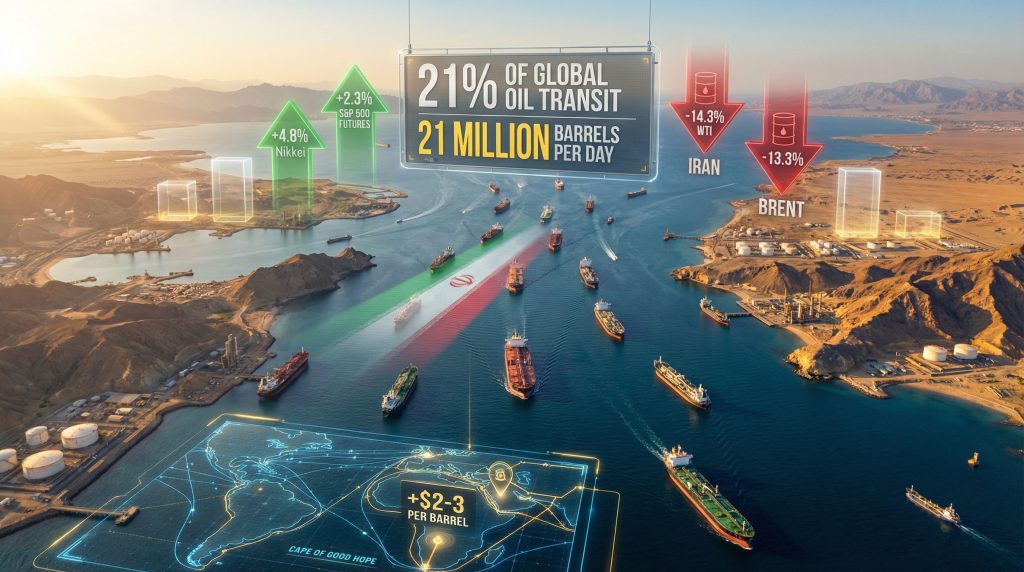
Iran and the US have reached a ceasefire agreement, contingent upon ensuring “safe passage” through the Strait of Hormuz.
Since the US and Israel’s assault on Iran on February 28, Tehran had effectively blocked this vital waterway, one of the busiest oil shipping routes globally.
Typically, around 20% of the world’s oil and liquefied natural gas (LNG) flows through the strait, and the recent conflict has caused global fuel prices to surge.
Following the ceasefire announcement, oil prices dropped approximately 15%.
The Strait of Hormuz, bordered by Iran to the north and Oman and the UAE to the south, is a crucial maritime corridor, just 50 km (31 miles) wide at its entrances and exits and about 33 km at its narrowest point. This strait connects the Gulf to the Arabian Sea and accommodates the largest crude oil tankers.
In 2025, an estimated 20 million barrels of oil and oil products passed through the strait daily, representing nearly $600 billion in annual energy trade. This oil originates not only from Iran but also from other Gulf nations like Iraq, Kuwait, Qatar, Saudi Arabia, and the UAE.
Around 20% of global LNG also transits through the strait, predominantly from Qatar, which exported about 9.3 billion cubic feet per day (Bcf/d) in 2024, while the UAE contributed approximately 0.7 Bcf/d.
LNG, converted to liquid for transport, occupies 600 times less space and is reverted to gas at its destination for heating, cooking, and power generation.
Hormuz also serves as a key route for Middle Eastern fertilizer exports, with natural gas being essential in production. Typically, one-third of the world’s fertilizer trade passes through this strait.
Additionally, the strait is vital for importing food, medicines, and technology into the Middle East.
The closure of the strait has had significant repercussions. Normally, about 3,000 ships navigate the waterway each month, but this number plummeted amid threats from Iran to target tankers and other vessels.
UN regulations permit countries to control territorial seas up to 12 nautical miles from their shores. At its narrowest point, the shipping lanes of the Strait of Hormuz lie entirely within Iranian and Omani territorial waters.
Iran’s use of drones, missiles, fast attack boats, and potentially mines posed serious risks to vessels attempting to transit the strait.
By April 2, the non-profit United Against Nuclear Iran reported at least 24 commercial vessels had been attacked, with three near misses.
“You risk being attacked, making insurance either unavailable or prohibitively expensive,” stated Arne Lohmann Rasmussen, chief analyst at Global Risk Management.
Gulf nations, including Iran, heavily depend on energy exports for revenue, and the strait’s disruption has adversely affected Asia, particularly China, which purchases around 90% of Iran’s oil exports.
In Asia, the fuel crisis has prompted governments to implement measures such as remote work, shortened workweeks, national holidays, and early university closures to conserve energy.
In Africa, South Sudan and Mauritius have announced electricity consumption restrictions, while Slovenia has become the first EU member to initiate fuel rationing.
The US has not deployed warships to the strait, focusing its military response on airstrikes against Iranian anti-ship missile sites.
On March 18, the US military reported bombing these sites. Former President Trump urged both allies and China to send warships to secure Hormuz, but the response was lukewarm, leading him to assert that the US could manage alone.
Historically, the US has employed military force to restore maritime traffic through the strait. During the late 1980s, amid the Iran-Iraq war, a “tanker war” ensued, with both nations attacking neutral ships to exert economic pressure.
Eventually, American warships began escorting Kuwaiti tankers through the Gulf, marking one of the largest naval operations since World War II.
Before the ceasefire, Iran announced it would allow “non-hostile vessels” to transit the Strait of Hormuz with coordination from “competent Iranian authorities.”
Between March 1 and 20, approximately 100 ships successfully navigated the strait, according to BBC Verify analysis. Notably, a French container ship and three Oman-linked tankers crossed on April 3, marking key crossings during this period.
Despite the ceasefire, daily traffic had decreased by about 95% since the onset of hostilities on February 28.
Approximately one-third of recent crossings involved vessels linked to Iran, with 11 China-linked ships reported to have transited between March 1 and 15.
On March 31, China expressed gratitude after three of its ships, including two container vessels from state-owned shipping giant Cosco, successfully passed through the strait. At least eight Indian-flagged LPG carriers also navigated the waterway.
To mitigate the risks associated with Hormuz, oil-exporting countries in the Gulf have developed alternative overland routes.
Saudi Arabia operates a 1,200 km East-West Crude Oil Pipeline, capable of transporting up to five million barrels of crude oil daily. Additionally, the UAE has connected its inland oilfields to the port of Fujairah on the Gulf of Oman via a pipeline with a capacity of at least 1.5 million barrels daily.
While oil can be redirected through this alternate infrastructure, reports indicate it may lead to a supply drop of 8-10 million barrels per day. Furthermore, drone attacks have disrupted oil loading at Fujairah.


