

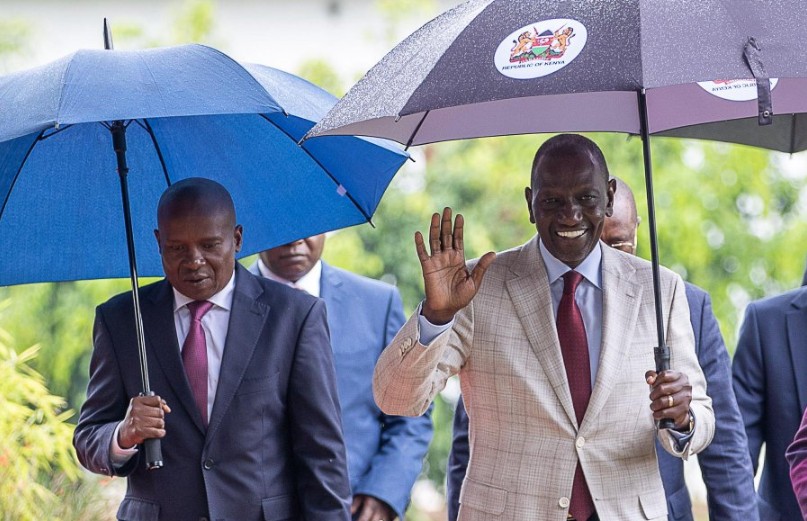
President William Ruto has established himself as a leader who meticulously navigates political landscapes. His ongoing silence regarding the speculation surrounding Deputy President Kithure Kindiki is garnering attention equal to the controversy itself.
The question of whether recent reports about the reassignment of responsibilities from the Deputy President’s office reflect a genuine loss of influence is secondary. In politics, perceptions often weigh as heavily as formal authority.
The belief that Kindiki’s political standing is weakening has gained momentum, primarily because the President has neither publicly endorsed his deputy nor addressed the swirling speculation directly.
Kindiki has labeled claims of losing power as misinformation, while senior government officials maintain that constitutional and statutory roles remain intact. This legal argument carries weight. According to Kenya’s Constitution, the Deputy President undertakes functions assigned by the President and acts as the President’s chief assistant.
Although the office is constitutionally protected, its daily influence is largely shaped by the President’s trust and delegation of responsibilities.
This distinction clarifies why the current discourse holds such political significance. Just months ago, Kindiki seemed firmly in command of his political narrative, leading government development tours and advocating for administration policies. Today, the conversation has shifted from his growing influence to concerns about potential political isolation.
Even the late-night meeting with Ruto at State House appears more like a photo opportunity as the UDA leader grapples with the complexities of the 2027 reelection strategy.
These perceptions are critical because Kenyan politics has witnessed similar patterns before. Former Deputy President Rigathi Gachagua frequently expressed feelings of being sidelined well before his eventual ousting. Many dismissed his claims as mere political grievances, yet Gachagua now contends that Kindiki is facing a similar strategy of gradual isolation.
While the two situations are not identical, the comparison has gained traction due to the noticeable decrease in joint appearances between Ruto and Kindiki, alongside the increasing speculation about the Deputy President’s role.
President Ruto could swiftly alleviate the political tension by publicly reaffirming his support for Kindiki. Instead, he has permitted competing narratives to thrive. In politics, silence rarely remains neutral; it often transforms into a political statement, inviting interpretations from allies, opponents, and the public alike.
The timing further fuels speculation. With the 2027 General Election on the horizon, succession politics increasingly influence governmental decisions. Visible cabinet rivalries and ongoing discussions about potential political realignments dominate the political landscape in Kenya.
The rising prominence of Prime Cabinet Secretary Musalia Mudavadi and Cooperative Cabinet Secretary Wycliffe Oparanya has intensified discussions about prospective changes within the Kenya Kwanza coalition and broader alliances ahead of the upcoming election.
For Kindiki, the political balancing act becomes more precarious. He must demonstrate unwavering loyalty to President Ruto while maintaining his credibility in the politically influential Mt. Kenya region, where competition for leadership has intensified since the fallout with former allies. Any perception of dwindling influence in Nairobi inevitably impacts his political standing back home.
His recent assertion that “we are not going anywhere” aimed to reassure supporters. However, politicians rarely feel the need to deny rumors unless those rumors have gained substantial traction.
Ultimately, the controversy reflects not only on Kindiki’s political future but also on President Ruto’s governing style. Since assuming office in 2022, Ruto has consistently favored maintaining tight control over his political coalition while navigating competing ambitions within the government.
Strategic ambiguity can bolster presidential authority by keeping allies reliant on State House, but it also poses risks. Ongoing uncertainty breeds mistrust, undermines internal cohesion, and provides opportunities for rivals to shape the political narrative.
If Kindiki continues to enjoy the President’s full confidence, there is little to lose by publicly stating so. If broader political calculations are in play, Kenyans deserve transparency from their leaders.
Until President Ruto articulates his stance unequivocally, every silence will be perceived as a deliberate strategy rather than mere coincidence. In Kenyan politics, uncertainty often serves as a tool of power.
Whether intentionally or not, Kindiki has become the latest figure ensnared in this dynamic, and how this situation develops could significantly influence both the stability of the Kenya Kwanza administration and the contest for power leading up to the 2027 General Election.


