

For decades, Tanzania’s Chama Cha Mapinduzi (CCM) has established itself as one of Africa’s most disciplined and resilient ruling parties, adeptly managing internal rivalries while projecting an image of political unity.
The unexpected resignation of Vice-President Emmanuel Nchimbi has provided a rare insight into the consequences of that unity unraveling.
Nchimbi resigned on August 25, 2026, less than a year into his term, citing President Samia Suluhu Hassan’s desire for change and his decision to step away from politics and public service. His resignation was initially scheduled to take effect on September 4, 2026.
However, the political landscape shifted rapidly. Just one day after announcing his resignation, Nchimbi faced expulsion from CCM, which the party attributed to violations of its disciplinary and ethical standards. The party did not specify the actions that led to this decision.
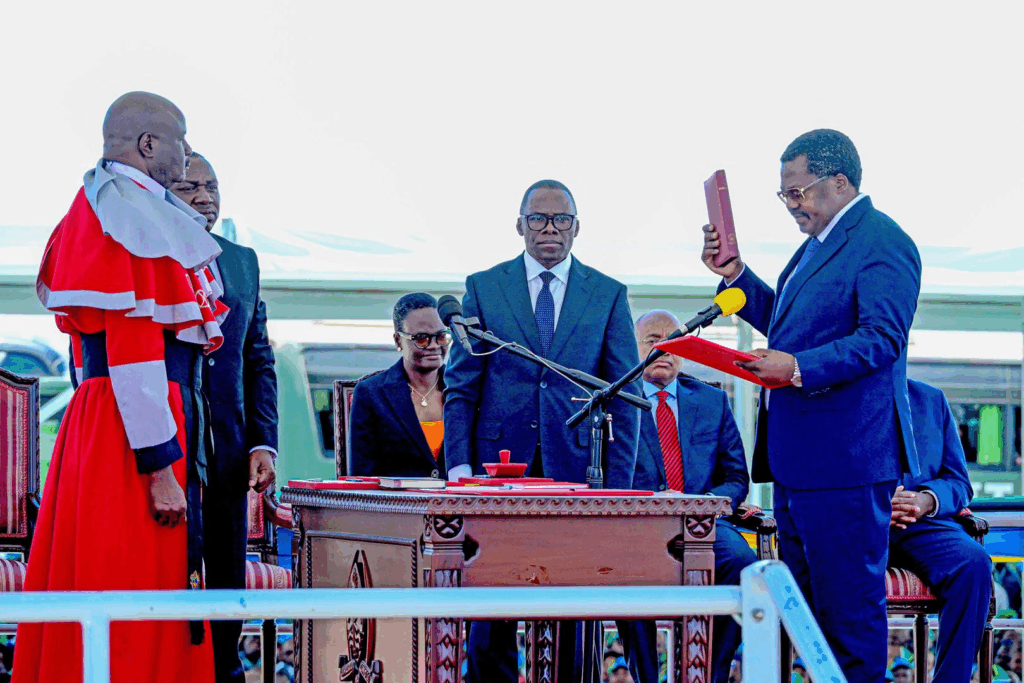
In a swift response, CCM nominated Energy Minister Deogratius Ndejembi as Nchimbi’s successor. Parliament unanimously approved Ndejembi on Friday, with all 324 lawmakers endorsing his appointment.
This sequence of events has transformed what might have been a routine leadership transition into a significant test of President Hassan’s authority and the extent of dissent the ruling establishment can accommodate.
A resignation that raises critical questions
Nchimbi was not an outsider; he previously served as CCM secretary-general before becoming Hassan’s running mate and vice-president. His abrupt departure from both the government and the ruling party carries substantial weight.
Recent reports indicate that Nchimbi advocated for a new national constitution at a public event, emphasizing a framework that promotes economic development alongside the dignity and worth of every Tanzanian. His remarks drew criticism within CCM, potentially exacerbating internal tensions.
While it remains unclear whether his push for constitutional reform led to his departure, the timing raises important questions.
For a party accustomed to resolving disagreements internally, the combination of a vice-president’s resignation, immediate expulsion, and rapid succession suggests deeper issues than a standard personnel change.
Political analyst Buberwa Kaiza noted that Nchimbi’s expulsion reflects ongoing tensions within CCM.
“I interpret CCM’s expulsion of Nchimbi as an indication of a conflict that has been simmering within the party,” Kaiza stated.
This interpretation is significant but should not be mistaken for evidence that CCM is fracturing. The party continues to maintain control over the government and Parliament, and its swift replacement of Nchimbi demonstrates its organizational strength.
Dissent comes with consequences
This episode reveals a paradox at the heart of Samia’s presidency.
Hassan has demonstrated her capacity to enforce political discipline quickly. Yet, the need for such rapid measures raises questions about how internal disagreements regarding government direction are managed within CCM.
The situation became more pronounced when Attorney-General Hamza Johari announced in Parliament that Nchimbi ceased to be vice-president on August 26, the day after his resignation announcement, due to the loss of his CCM membership. This effectively concluded his tenure ahead of the September 4 date mentioned in his resignation letter.
This development highlights the unusual overlap between party membership and executive authority in Tanzania, where control of CCM is central to political power.
It also refocuses attention on Hassan’s management of the party following the 2025 election, which saw her achieve a landslide victory but was marred by deadly unrest. A government inquiry revealed that at least 518 individuals lost their lives during election-related violence, according to Reuters.
In this context, internal disagreements among senior CCM figures carry implications that extend beyond the party itself.
The significance of Ndejembi’s rise
The selection of Ndejembi introduces a generational aspect to this episode.
At just 43, the former energy minister symbolizes a younger generation of CCM leadership. Hassan has framed his appointment as part of a broader effort to reinvigorate the vice-presidency with youthful leaders, encouraging him to “grow, not in age but in wisdom.”
Ndejembi has emphasized his loyalty to the presidency, positioning himself as a bridge to the Tanzanian populace “in accordance with her directives.”
His swift ascent may signify more than just filling a vacant position; it could indicate Hassan’s preference for a younger leadership team closely aligned with her political vision.
Whether Ndejembi emerges as a formidable political figure in his own right or primarily as a trusted member of Hassan’s inner circle will unfold over time.
A test of Samia’s political model
The Nchimbi incident does not indicate that CCM is on the verge of collapse. If anything, the party has showcased its capability to swiftly remove a senior figure and fill the vacancy with remarkable efficiency.
The more pressing question is the kind of unity Hassan aspires to cultivate.
Historically, CCM’s resilience has relied on its ability to manage competing interests without allowing disagreements to destabilize the party. Nchimbi’s exit suggests that the boundaries of acceptable dissent may now be under closer scrutiny.
For Hassan, this presents a delicate balancing act: maintaining control of a party that has governed Tanzania for decades while assuring the public that political stability does not necessitate the suppression of internal debate.
Nchimbi’s political career may not be over. CCM has a history of reinstating expelled members, and Kaiza suggests that Nchimbi could continue to influence political discourse even outside the party.
Thus, the former vice-president’s next steps are worth monitoring.
Ultimately, the most apparent lesson from his departure is not that CCM has fractured beyond repair, but that a party known for managing its divides behind closed doors has, for once, allowed the public to witness the strain.
For Samia, the challenge now extends beyond merely maintaining control. It involves demonstrating that control, party discipline, and political legitimacy can coexist without equating unity with silence.


