

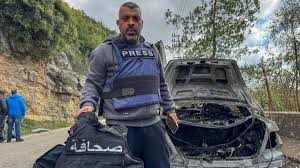
Lebanese president condemns attack as “blatant crime” as Israel confirms killing of Al Manar reporter, alleging Hezbollah affiliation.
Three Lebanese journalists have been killed in a targeted Israeli strike on their media vehicle in southern Lebanon, local media reported, marking the latest in a series of attacks on journalists in the country since hostilities escalated.
Ali Shoeib, a reporter for Al Manar TV — a network operated by the militant group Hezbollah — along with Al Mayadin reporters Fatima and Mohamed Fetoni, were killed in an air strike in the town of Jezzine. The strike, which hit their vehicle in broad daylight, has drawn sharp condemnation from Lebanese officials and press freedom advocates.
Lebanese President Joseph Aoun condemned the attack as a “blatant crime” that violates international law, under which journalists are supposed to be protected during armed conflict. He called for an international investigation into the incident, accusing Israeli forces of deliberately targeting media professionals.
Israel’s military confirmed that it killed Ali Shoeib in the strike but disputed the characterization of the victims as journalists. In a statement, the Israel Defense Forces (IDF) accused Shoeib of being a Hezbollah operative who was posing as a journalist, alleging that he was involved in militant activities. The IDF did not immediately comment on the deaths of the two Al Mayadin journalists, both of whom were also killed in the same strike.
The attack has intensified fears among journalists and human rights organizations that media workers are being deliberately targeted in the conflict. This is the second time Israel has been accused of targeting journalists in Lebanon since the current round of hostilities began. Last week, Mohammad Sherri, a prominent presenter at Al Manar TV, and his wife were killed in a targeted strike that drew widespread condemnation from press freedom groups.
Local media organizations have described the killings as part of a troubling pattern of violence against journalists covering the conflict. The Lebanese Ministry of Information issued a statement condemning what it called “systematic targeting” of media professionals, urging the international community to take immediate action to protect journalists operating in conflict zones.
Press freedom advocates have noted that journalists in Lebanon are facing increasing risks while covering the war, with several media workers having been killed or injured in Israeli airstrikes over the past weeks. The Committee to Protect Journalists (CPJ) has called for an independent investigation into the deaths, emphasizing that journalists are civilians entitled to protection under international humanitarian law.
So far, more than 1,100 civilians, including 120 children and 42 paramedics, have been killed in Israeli airstrikes in Lebanon, according to local health authorities. The rising civilian toll has sparked growing international concern over the conduct of the military campaign.
Many in Lebanon have expressed alarm that Israel is employing tactics similar to those it has been accused of deploying in Gaza — including the deliberate targeting of civilians, journalists, and paramedics, allegations that Israel has consistently denied. Israeli officials maintain that their operations are aimed exclusively at Hezbollah militants and that civilian casualties are unintended consequences of legitimate military actions.
The strike in Jezzine comes amid escalating tensions along the Lebanon-Israel border, where near-daily exchanges of fire have occurred since the outbreak of the war in Gaza. Hezbollah, which maintains a significant military and media presence in Lebanon, has been engaged in cross-border clashes with Israeli forces, raising fears of a broader regional conflagration.
Funeral processions for the three journalists were held in Beirut on Saturday, drawing large crowds of mourners, including journalists, politicians, and members of Hezbollah. Speakers at the ceremonies accused Israel of waging a war against Lebanese media in an effort to silence coverage of the conflict.
The Israeli military has not provided evidence to support its claim that Shoeib was a Hezbollah operative, and the allegation has been rejected by both his family and colleagues, who described him as a professional journalist who had worked for Al Manar for over a decade.
As the conflict continues, press freedom organizations have reiterated calls for all parties to respect the protections afforded to journalists under international law. The Geneva Conventions explicitly prohibit the targeting of civilians, including journalists, and mandate that media personnel be treated as civilians unless they are directly participating in hostilities.
The deaths of the three journalists add to a growing list of media workers killed in the region since October 2023, making the Israel-Gaza war and its spillover into Lebanon one of the deadliest conflicts for journalists in recent history.