

A
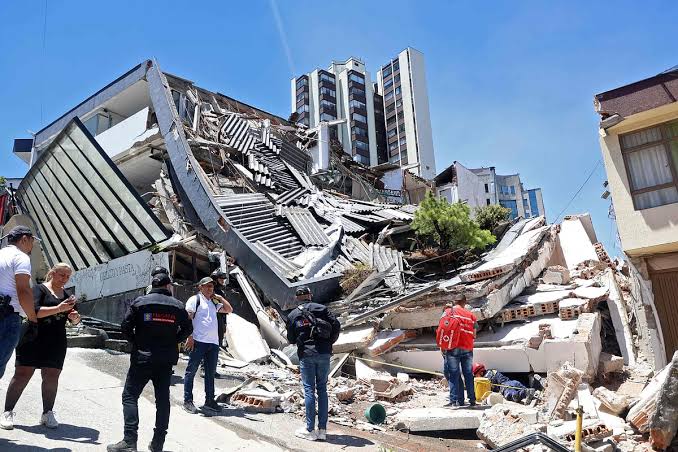
A davestating earthquake has struck Colombia, claiming the lives of at least 110 individuals and prompting a state of emergency. As rescue efforts continue, authorities anticipate the death toll may rise, with many people feared trapped beneath collapsed structures.
The earthquake, registering a magnitude of 7.4, occurred at 07:34 local time (12:34 GMT) at a depth of 103 kilometers in Chocó province. Its effects were felt across a vast area, extending hundreds of miles throughout western Colombia.
The city of Pereira, located in the coffee-growing region, has reported the highest number of casualties, with surrounding cities and the Valle del Cauca region also experiencing significant devastation. While the epicenter was near the village of San José del Palmar, local mayor León Fabio Marín Moncada reported no fatalities or injuries in that area, despite damage to roads.
Pereira has emerged as one of the worst-hit locations. Approximately 55 kilometers from the epicenter, the city witnessed severe destruction. Verified videos show at least one building collapsing in Plaza Bolívar, the city’s main square, where debris and dust now cover the area once bustling with people.
Local officials have confirmed at least 40 deaths in the metropolitan area of Pereira, with 65 buildings reported as collapsed. Rescue teams are currently working to locate individuals trapped in 15 of these structures. A curfew is in effect in certain parts of the city until 05:00 local time on Tuesday.
In Cali, about 160 kilometers south of Pereira and roughly 200 kilometers from the epicenter, 32 buildings have collapsed. Dan Cutler, a 29-year-old London resident visiting Colombia, described his experience of the earthquake, stating, “I’ve never experienced anything like it.” He noted that while the hotel sustained no major structural damage, surface cracks appeared on the walls.
Reports of casualties have also emerged from Manizales, Quibdó, and Medellín throughout the Chocó and Valle del Cauca regions. In Manizales, at least two fatalities have been confirmed. Angélica Ávila, who was staying in a hotel during the quake, recounted the scene of chaos as cracks formed in the walls and dust filled the air.
Luis Felipe Molina, a journalist and meteorologist in Manizales, shared that the city’s stringent seismic-resistant building regulations helped minimize damage. He described the frightening experience, stating, “You could hear glass breaking and people screaming.”
The aviation authority has reported damage at several regional airports, including those in Pereira, Manizales, Quibdó, Armenia, Cartago, and Buenaventura. In Bogotá, the capital, trees and traffic lights shook violently, with some building cracks reported, though no serious infrastructure damage has been confirmed.
Tremors were felt in neighboring countries, including Venezuela, Ecuador, and Panama.
In response to the crisis, President Abelardo de la Espriella has declared a national disaster, granting special powers to address the emergency and reallocate budgets. Having assumed office just days prior, the new president faces a significant challenge as he navigates this potentially legacy-defining situation. He confirmed that over 1,500 homes have suffered damage.
As the extent of the disaster unfolds, global leaders have expressed their support. U.S. Secretary of State Marco Rubio stated that the U.S. is “closely monitoring” the situation and is “ready to support.” Meanwhile, EU Chief Ursula von der Leyen announced that the EU’s Copernicus satellite is being utilized in rescue operations. President Nayib Bukele of El Salvador extended a message of solidarity and offered personnel and equipment for rescue efforts.
According to the U.S. Geological Survey, an estimated 1.5 million people felt the earthquake’s impact. While deep earthquakes like this one are typically less dangerous than those occurring closer to the surface, they can still cause significant damage to buildings and may result in fewer but stronger aftershocks.