
Thirty-four days ago, Spain launched their World Cup journey with a disappointing goalless draw against tournament newcomers Cape Verde.
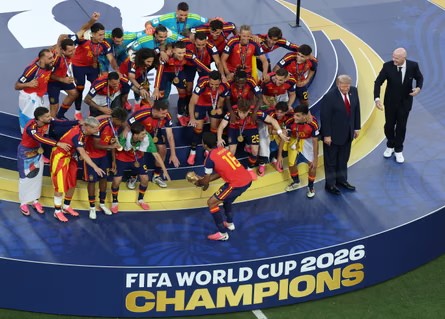
On Sunday, they concluded this journey by hoisting the World Cup trophy after triumphing over reigning champions Argentina in the final held in New Jersey.
Under the guidance of Luis de la Fuente, this young team made remarkable progress throughout the tournament, steadily increasing their performance as they advanced through the knockout stages, ultimately emerging victorious in the most significant match.
Spain allowed only one goal throughout the tournament and maintained an impressive unbeaten streak, now extending to an astonishing 38 matches.
This culminated in a commanding final display by La Roja, who expertly controlled the game and neutralized Argentina’s offensive threats.
Let’s explore how Spain claimed their second World Cup title.
Embracing Youth
Spain entered this tournament with one of the youngest squads, boasting an average age of 26.19 and only six players over 30. In contrast, Brazil fielded 11 players aged over 30 with an average age of 28.65.
La Roja made a bold choice to prioritize youth, and it paid off handsomely. Their standout players included teenagers like Pau Cubarsi and Lamine Yamal, both just 19 years old. Nico Williams, who provided the winning assist in the final, is 24, while Barcelona’s Pedri is 23.
A Slow Start
Spain kicked off their World Cup campaign in Atlanta against debutants Cape Verde in mid-June. The European champions struggled to break through the African side and their stellar goalkeeper Vozinha, resulting in a surprising goalless draw.
This left many questioning Spain’s prospects in the tournament. However, they rebounded impressively, dominating Saudi Arabia in their next group match and edging past Uruguay 1-0 in Guadalajara.
The eventual champions smoothly advanced past Austria in the Round of 32, but showcased their determination in the subsequent knockout matches. Super-sub Mikel Merino emerged as a crucial player, scoring late winners against both Portugal and Belgium to secure their spot in the semifinals.
Collective Strength Over Individual Glory
Spain’s 2-1 victory over Belgium in the quarterfinals marked another instance where Yamal did not find the back of the net. When questioned about his performance post-match, he wisely noted that “no one will remember whether I scored goals” if Spain secured the trophy.
And he was absolutely right. Mikel Oyarzabal led the team with five goals in North America, while the rest of the squad also contributed significantly. Mikel Merino and Pedro Porro each scored twice, and Ferran Torres netted the decisive goal that won Spain the World Cup.
Despite not scoring, Yamal played a pivotal role for La Roja, participating in every match and earning the player of the match title for his performance against Belgium. He also won a penalty that set the stage for Spain’s opening goal against France in the semifinals.
Rising to the Challenge in the Semifinals
After smoothly navigating their first three knockout matches, France emerged as strong favorites to win the tournament, but Spain had other plans. Coach de la Fuente executed a tactical masterpiece in the semifinal against Les Bleus, effectively neutralizing one of the world’s most formidable attacking teams in a 2-0 victory.
Spain’s midfield trio of Dani Olmo, Rodri, and Fabian Ruiz dominated possession and controlled the game’s tempo from the outset. Their midfield prowess prevented France from utilizing their star attackers, including Kylian Mbappe and Michael Olise.
La Roja unsettled their opponents by taking the lead midway through the first half and relentlessly pushing for a second goal, never allowing France to gain momentum and limiting them to long-range attempts.
Mastering the Final
Spain maintained the same starting lineup for the final, a decision that proved wise. They replicated their semifinal strategy, controlling possession and frustrating their opponents throughout the match.
Argentina managed only two shots in 120 minutes, neither of which were on target. Spain dominated with 65 percent possession, wearing down the South Americans both mentally and physically.
Argentina’s frustration peaked in second-half stoppage time when Enzo Fernandez’s reckless challenge on Cubarsi earned him a second yellow card. Meanwhile, Spain, with fresh legs from players like Pedri, Williams, and Torres, continued to assert their dominance. They finally broke through in the 106th minute when Torres powerfully struck the ball into the net.
A Bright Future Ahead for Spain
As world and European champions, Spain boasts a youthful squad poised to dominate international football in the coming years. Many players have yet to reach their peak performance, and they will undoubtedly aim for more tournament success, including a home World Cup in four years.
Stars like Yamal, Cubarsi, Pedri, and Williams will be in their prime by 2030, and Spain’s possession-based style will be advantageous in hot summer conditions.
They will also be confident in their chances to retain the European Championship in two years, with the UK and the Republic of Ireland hosting the tournament.
De la Fuente has extended his contract until 2028, setting the stage for further success on the international scene.