
The Hungarian parliament has decisively voted to remove President Tamás Sulyok from office. Observers widely regarded Sulyok as a loyalist to former Prime Minister Viktor Orbán, who lost power in April after a remarkable 16-year tenure.
In a significant move, Prime Minister Péter Magyar’s Tisza party utilized its two-thirds majority to push through the 17th amendment to the constitution, effectively ending the terms of both Sulyok and the head of the Constitutional Court, Péter Polt. This marked one of the most dramatic moments in parliament since the new government assumed office in early May, following an unexpected landslide victory against Orbán’s Fidesz party on April 12.
Sulyok now faces a critical decision: he has five days to either sign the amendment—essentially sealing his political fate—or refer it to the Constitutional Court. Should he choose the latter, Magyar has indicated that he will initiate impeachment proceedings against him, which would automatically suspend Sulyok from office.
Alternatively, Sulyok could consider resigning to prevent a constitutional crisis, a step the new government has strongly encouraged for the greater good of the nation.
In a show of dissent, deputies from the now-opposition Fidesz party exited the parliament before the vote, accusing the Tisza party of fostering tyranny. Fidesz claims that the amendment grants the government the unchecked power to dismiss any public official immediately.
“The great irony is that Fidesz has fallen victim to its own notion of power,” observed Péter Rona, a former opposition presidential candidate, during a BBC interview. He noted that the 2011 constitution, crafted by Orbán’s administration, established the principle that “the winner takes all.”
From 2010 to 2026, Fidesz restructured the Hungarian state to align with its interests, filling independent state positions with party loyalists, leveraging its own two-thirds majority.
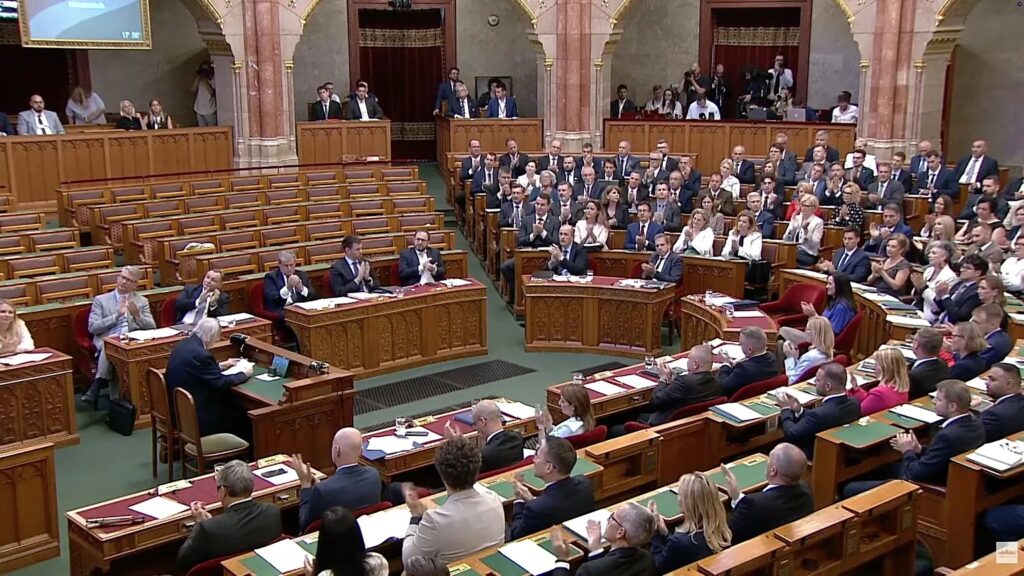
As the results of the vote were announced, the 141 Tisza deputies in parliament celebrated with a standing ovation. The amendment further includes provisions to remove Constitutional Court judges over the age of 70 and to bar deputies who have served three terms in parliament from running again, a rule that affects more than half of the current Fidesz deputies.
“I fully support the removal of the president,” stated András Baka, former head of the Supreme Court, in a BBC interview. He emphasized that Hungary enjoyed governance under the rule of law from 1989 to 2010, but after that, Fidesz took control of state institutions and established an authoritarian regime. “It is now incredibly challenging to dismantle a sophisticated authoritarian structure designed to endure even after electoral defeat,” Baka remarked.
The 17th amendment encompasses a comprehensive package of laws intended to steer the country until a new constitution can be adopted in the next two to three years. Baka expressed concern over the section preventing parliamentary deputies who have served three terms from running again, arguing, “This restricts the public’s right to vote for their preferred candidates.”
Following the April election, Orbán’s party has faced a steep decline, grappling with the shock of defeat. Orbán himself has been largely absent from public view and declined to take his seat in parliament. On Monday, he departed Hungary to attend the finals of the football World Cup in the U.S.
Dissent is growing within the remnants of Fidesz, with many expressing frustration over Orbán’s absence. Gergely Gulyás, the party’s second-in-command, resigned as head of the parliamentary group on Monday, compounding the party’s challenges.